
Pearson+ LogoPearson+ Logo
Ch. 7 Photosynthesis: Using Light to Make Food
Taylor - Campbell Biology: Concepts & Connections 10th Edition
Taylor, Simon, Dickey, Hogan10th EditionCampbell Biology: Concepts & ConnectionsISBN: 9780136538783Not the one you use?Change textbook
Chapter 7, Problem 12

What do plants do with the sugar they produce in photosynthesis?

Verified step by step guidance
1
Understand that photosynthesis is a process where plants convert light energy into chemical energy stored in glucose (a type of sugar).
Recognize that the glucose produced during photosynthesis serves as a primary energy source for the plant.
Learn that plants use some of the glucose directly to generate energy through cellular respiration, which powers all their metabolic activities.
Acknowledge that glucose not immediately used for energy can be stored as starch in various parts of the plant such as roots, stems, and leaves for later use.
Explore how plants also use glucose as a building block to synthesize other important biological molecules such as cellulose, which is crucial for cell wall construction and overall structural support.

Verified video answer for a similar problem:

This video solution was recommended by our tutors as helpful for the problem above.
Video duration:
1m
Was this helpful?

Key Concepts

Here are the essential concepts you must grasp in order to answer the question correctly.

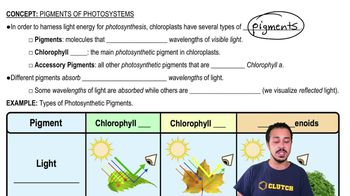
Photosynthesis

Photosynthesis is the biochemical process by which green plants, algae, and some bacteria convert light energy into chemical energy. During this process, plants use sunlight, carbon dioxide, and water to produce glucose (sugar) and oxygen. The overall reaction can be summarized by the equation: 6CO2 + 6H2O + light energy → C6H12O6 + 6O2.
Recommended video:
Guided course
05:58
Pigments of Photosynthesis

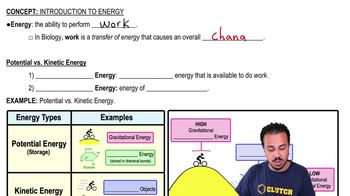
Energy Storage and Utilization

Plants utilize the glucose produced during photosynthesis as a primary energy source. This sugar can be stored in the form of starch for later use, particularly during periods of low light or dormancy. Additionally, glucose is used in cellular respiration to generate ATP, the energy currency of cells, which powers various metabolic processes.
Recommended video:
Guided course
04:58
Introduction to Energy

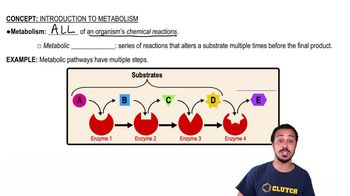
Metabolic Pathways

Metabolic pathways are series of chemical reactions occurring within a cell that convert substrates into products. In plants, glucose can be further processed through pathways such as glycolysis and the citric acid cycle, leading to the production of energy, or it can be converted into other organic compounds like cellulose for structural support or sucrose for transport.
Recommended video:
Guided course
02:17
Introduction to Metabolism
Related Practice