Textbook Question
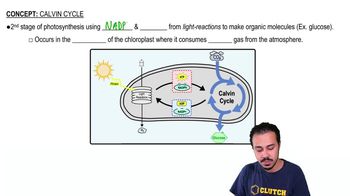
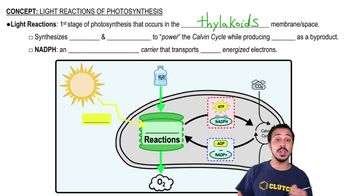
In photosynthesis, _________ is oxidized and _________ is reduced.
a. Water . . . Oxygen
b. Carbon dioxide . . . Water
c. Water . . . Carbon dioxide
d. Glucose . . . Carbon dioxide
1437
views



 Taylor, Simon, Dickey, Hogan 10th EditionCh. 7 Photosynthesis: Using Light to Make FoodProblem 5
 Verified step by step guidance
 03:42
03:42
 04:06
04:06 06:04
06:04In photosynthesis, _________ is oxidized and _________ is reduced.
a. Water . . . Oxygen
b. Carbon dioxide . . . Water
c. Water . . . Carbon dioxide
d. Glucose . . . Carbon dioxide
Which of the following are produced by reactions that take place in the thylakoids and consumed by reactions in the stroma?
a. CO₂ and H₂O
b. ATP and NADPH
c. ATP, NADPH, and CO₂
d. ATP, NADPH, and O₂
When light strikes chlorophyll molecules in the reaction-center complex, they lose electrons, which are ultimately replaced by
a. Splitting water
b. Oxidizing NADPH
c. The primary electron acceptor
d. The electron transport chain
Which of the following does not occur during the Calvin cycle?
a. Carbon fixation
b. Oxidation of NADPH
c. Consumption of ATP
d. Release of oxygen
Why is it difficult for C3 plants to carry out photosynthesis in very hot, dry environments such as deserts?
a. The light is too intense and destroys the pigment molecules.
b. The closing of stomata keeps CO₂ from entering and O₂ from leaving the plant.
c. They must rely on photorespiration to make ATP.
d. CO₂ builds up in the leaves, blocking carbon fixation.
How is photosynthesis similar in C4 plants and CAM plants?
a. In both cases, the light reactions and the Calvin cycle are separated in both time and location.
b. Both types of plants make sugar without the Calvin cycle.
c. In both cases, rubisco is not used to fix carbon initially.
d. Both types of plants make most of their sugar in the dark.