Pearson+ LogoPearson+ Logo
Ch. 32 Plant Nutrition and Transport
Taylor - Campbell Biology: Concepts & Connections 10th Edition
Taylor, Simon, Dickey, Hogan10th EditionCampbell Biology: Concepts & ConnectionsISBN: 9780136538783Not the one you use?Change textbook
Chapter 32, Problem 3

Which of the following activities of soil bacteria does not contribute to creating usable nitrogen supplies for plant use?
a. The fixation of atmospheric nitrogen
b. The conversion of ammonium ions to nitrate ions
c. The decomposition of dead animals
d. The assembly of amino acids into proteins

Verified step by step guidance
1
Step 1: Understand the role of soil bacteria in the nitrogen cycle. Soil bacteria are essential for converting nitrogen into forms that plants can use, such as ammonium (NH₄⁺) and nitrate (NO₃⁻). This process includes nitrogen fixation, nitrification, and decomposition.
Step 2: Analyze option (a): 'the fixation of atmospheric nitrogen.' Nitrogen fixation is performed by certain bacteria (e.g., Rhizobium) that convert atmospheric nitrogen (N₂) into ammonia (NH₃), which can be further processed into usable forms for plants. This activity contributes to creating usable nitrogen supplies.
Step 3: Analyze option (b): 'the conversion of ammonium ions to nitrate ions.' This process, known as nitrification, is carried out by nitrifying bacteria (e.g., Nitrosomonas and Nitrobacter). It transforms ammonium (NH₄⁺) into nitrate (NO₃⁻), a form of nitrogen that plants can readily absorb. This activity also contributes to usable nitrogen supplies.
Step 4: Analyze option (c): 'the decomposition of dead animals.' Decomposition is performed by decomposer bacteria, which break down organic matter, including proteins and nucleic acids, into simpler compounds like ammonium (NH₄⁺). This ammonium can then enter the nitrogen cycle, contributing to usable nitrogen supplies.
Step 5: Analyze option (d): 'the assembly of amino acids into proteins.' This activity does not contribute to creating usable nitrogen supplies for plants. Instead, it is a biological process within living organisms where amino acids are linked together to form proteins. This activity does not directly impact the nitrogen cycle or provide nitrogen in a form usable by plants.

Verified video answer for a similar problem:

This video solution was recommended by our tutors as helpful for the problem above.
Video duration:
2m
Was this helpful?

Key Concepts

Here are the essential concepts you must grasp in order to answer the question correctly.

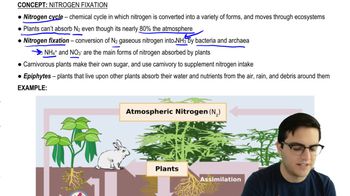
Nitrogen Fixation

Nitrogen fixation is the process by which certain bacteria convert atmospheric nitrogen (N2) into ammonia (NH3), making it available for plants. This is crucial because most plants cannot utilize atmospheric nitrogen directly. Instead, they rely on this conversion to access nitrogen in a form they can absorb and use for growth.
Recommended video:
Guided course
06:31
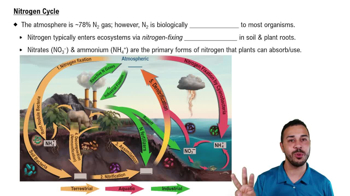
Nitrogen Cycle

Nitrification

Nitrification is a two-step process where ammonium ions (NH4+) are first oxidized to nitrites (NO2-) and then to nitrates (NO3-), which are forms of nitrogen that plants can readily absorb. This process is primarily carried out by specific soil bacteria and is essential for maintaining nitrogen availability in the soil.
Recommended video:
Guided course
08:32
Nitrogen Cycle

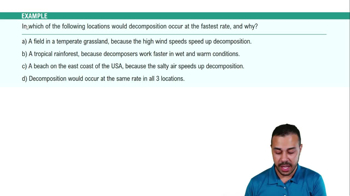
Decomposition

Decomposition is the breakdown of organic matter, such as dead plants and animals, by microorganisms, including bacteria. This process releases nutrients, including nitrogen, back into the soil in forms that can be utilized by plants. However, while decomposition contributes to nutrient cycling, it does not directly create usable nitrogen supplies like fixation or nitrification.
Recommended video:
Guided course
01:57
Introduction to Ecosystems Example 2