Pearson+ LogoPearson+ Logo
Ch. 32 Plant Nutrition and Transport
Taylor - Campbell Biology: Concepts & Connections 10th Edition
Taylor, Simon, Dickey, Hogan10th EditionCampbell Biology: Concepts & ConnectionsISBN: 9780136538783Not the one you use?Change textbook
Chapter 32, Problem 1

Fill in the blanks in this concept map to help you tie together key concepts concerning transport in plants.
Concept map illustrating transport in plants, focusing on water and sugar movement.

Verified step by step guidance
1
Step 1: Identify the source and destination of water and minerals in plants. Water and minerals are absorbed from the soil by the roots (a) and transported to the leaves.
Step 2: Determine the pathway through which water and minerals move. Water and minerals move through the xylem (b), which is specialized vascular tissue in plants.
Step 3: Understand the driving force for water and mineral transport. This movement is driven by transpiration (e), which creates a negative pressure in the xylem, pulling water upward.
Step 4: Identify the source and destination of sugar transport in plants. Sugars are produced in the leaves (c) during photosynthesis and transported to storage organs or roots (f).
Step 5: Determine the mechanism driving sugar transport. Sugar transport occurs through the phloem (d) and is driven by pressure flow, also known as the bulk flow mechanism.

Verified video answer for a similar problem:

This video solution was recommended by our tutors as helpful for the problem above.
Video duration:
2m
Was this helpful?

Key Concepts

Here are the essential concepts you must grasp in order to answer the question correctly.

Water and Mineral Transport

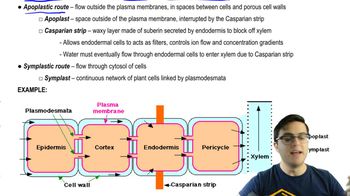
In plants, water and minerals are primarily absorbed by the roots from the soil and transported upward through specialized tissues called xylem. This movement is essential for maintaining plant hydration, nutrient uptake, and overall physiological functions. The process is driven by transpiration, where water evaporates from leaves, creating a negative pressure that pulls water upward.
Recommended video:
Guided course
07:59
How Water Enters Xylem

Sugar Transport

Sugar transport in plants occurs mainly through the phloem, which distributes the products of photosynthesis from the leaves to other parts of the plant. This process is vital for providing energy to non-photosynthetic tissues and is driven by a mechanism known as pressure flow, where differences in osmotic pressure facilitate the movement of sugars.
Recommended video:
Guided course
07:01
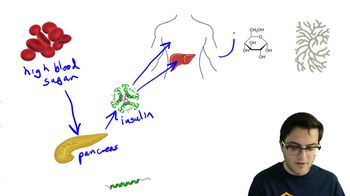
Blood Sugar Homeostasis

Pressure Flow Mechanism

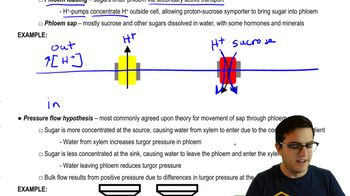
The pressure flow mechanism describes how sugars are actively transported into the phloem, creating a high osmotic pressure that draws water in from the xylem. This pressure difference drives the flow of the sugar solution from source regions (like leaves) to sink regions (like roots or fruits), ensuring that energy is efficiently distributed throughout the plant.
Recommended video:
Guided course
07:10
Pressure Flow Hypothesis