Pearson+ LogoPearson+ Logo
Ch. 31 Plant Structure, Growth, and Reproduction
Taylor - Campbell Biology: Concepts & Connections 10th Edition
Taylor, Simon, Dickey, Hogan10th EditionCampbell Biology: Concepts & ConnectionsISBN: 9780136538783Not the one you use?Change textbook
Chapter 31, Problem 2

In angiosperms, each pollen grain produces two sperm. What do these sperm do?
a. Each one fertilizes a separate egg cell
b. One fertilizes an egg, and the other is kept in reserve
c. Both fertilize a single egg cell
d. One fertilizes an egg, and the other fertilizes a cell that develops into stored food

Verified step by step guidance
1
Understand the process of double fertilization in angiosperms: Angiosperms (flowering plants) undergo a unique process called double fertilization, where two sperm cells from a single pollen grain are involved in fertilization.
Recall the role of the first sperm: One sperm cell fertilizes the egg cell, forming a diploid zygote, which will develop into the embryo of the seed.
Recall the role of the second sperm: The second sperm cell fuses with two polar nuclei in the central cell of the ovule, forming a triploid cell. This triploid cell develops into the endosperm, which serves as stored food for the developing embryo.
Eliminate incorrect options: a) is incorrect because only one egg is fertilized. b) is incorrect because the second sperm is not kept in reserve. c) is incorrect because both sperm do not fertilize the same egg.
Select the correct answer: The correct answer is d) One sperm fertilizes an egg, and the other fertilizes a cell that develops into stored food, which aligns with the process of double fertilization in angiosperms.

Verified video answer for a similar problem:

This video solution was recommended by our tutors as helpful for the problem above.
Video duration:
1m
Was this helpful?

Key Concepts

Here are the essential concepts you must grasp in order to answer the question correctly.

Double Fertilization

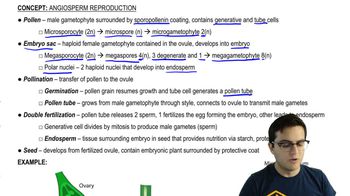
Double fertilization is a unique process in angiosperms where one sperm cell fertilizes the egg cell to form the zygote, while the other sperm cell fuses with two polar nuclei to form the triploid endosperm. This endosperm serves as a nutrient source for the developing embryo, making it crucial for seed development.
Recommended video:
Guided course
07:44
Double Fertilization

Pollen Grain Structure

A pollen grain in angiosperms contains two sperm cells and is the male gametophyte. Upon landing on a compatible stigma, it germinates and forms a pollen tube that delivers the sperm cells to the ovule, where fertilization occurs. Understanding this structure is essential for grasping how fertilization takes place.
Recommended video:
Guided course
04:25
Community Structure

Angiosperm Reproductive Cycle

The reproductive cycle of angiosperms involves the alternation of generations, where the diploid sporophyte produces haploid gametes through meiosis. This cycle includes the formation of flowers, pollination, fertilization, and seed development, highlighting the complex interactions between male and female gametes in plant reproduction.
Recommended video:
Guided course
04:14
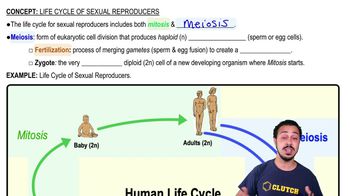
Life Cycle of Sexual Reproducers