Pearson+ LogoPearson+ Logo
Ch. 31 Plant Structure, Growth, and Reproduction
Taylor - Campbell Biology: Concepts & Connections 10th Edition
Taylor, Simon, Dickey, Hogan10th EditionCampbell Biology: Concepts & ConnectionsISBN: 9780136538783Not the one you use?Change textbook
Chapter 31, Problem 3-8

Match questions 3–8 with options a–f.
3. Attracts pollinator
4. Develops into seed
5. Protects flower before it opens
6. Produces sperm
7. Produces pollen
8. Houses ovules
a. Pollen grain
b. Ovule
c. Anther
d. Ovary
e. Sepal
f. Petal

Verified step by step guidance
1
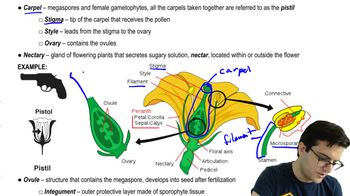
Step 1: Understand the function of each part of the flower mentioned in the options (a–f). For example, petals attract pollinators, sepals protect the flower before it opens, and the ovary houses ovules.
Step 2: Match question 3 ('Attracts pollinator') with the part of the flower responsible for this function. Recall that petals are brightly colored and designed to attract pollinators.
Step 3: Match question 4 ('Develops into seed') with the structure that contains the ovule, which after fertilization develops into a seed. This is the ovule itself.
Step 4: Match question 5 ('Protects flower before it opens') with the structure that encloses and protects the flower bud. This is the sepal.
Step 5: Match questions 6 ('Produces sperm') and 7 ('Produces pollen') with the male reproductive structures. The sperm is produced within the pollen grain, and the pollen is produced by the anther. Finally, match question 8 ('Houses ovules') with the ovary, which contains the ovules.

Verified video answer for a similar problem:

This video solution was recommended by our tutors as helpful for the problem above.
Video duration:
1m
Was this helpful?

Key Concepts

Here are the essential concepts you must grasp in order to answer the question correctly.

Pollination

Pollination is the process by which pollen is transferred from the male anther of a flower to the female stigma. This is a crucial step in the reproductive cycle of flowering plants, as it enables fertilization and the development of seeds. Pollinators, such as bees and butterflies, play a vital role in this process by facilitating the movement of pollen between flowers.
Recommended video:

Flower Structure

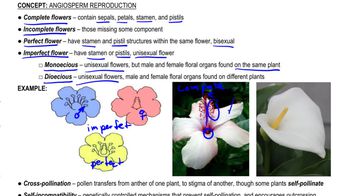
Flowers are complex structures composed of various parts, each serving specific functions. Key components include the anther, which produces pollen; the ovary, which houses ovules; and sepals, which protect the flower before it blooms. Understanding these structures is essential for comprehending how flowers reproduce and attract pollinators.
Recommended video:
Guided course
04:08
Flower Anatomy

Seed Development

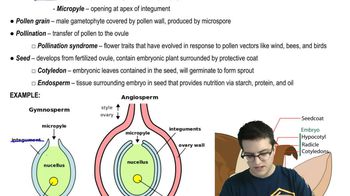
Seed development occurs after fertilization, when the fertilized ovule transforms into a seed within the ovary. This process is critical for the propagation of flowering plants, as seeds contain the genetic material necessary for the next generation. The ovary matures into a fruit, which aids in seed dispersal, ensuring the continuation of the species.
Recommended video:
Guided course
06:26
Seed Plants - 1