Pearson+ LogoPearson+ Logo
Ch. 36 Population Ecology
Taylor - Campbell Biology: Concepts & Connections 10th Edition
Taylor, Simon, Dickey, Hogan10th EditionCampbell Biology: Concepts & ConnectionsISBN: 9780136538783Not the one you use?Change textbook
Chapter 36, Problem 15

Many people regard the rapid population growth of developing countries as our most serious environmental problem. Others think that the growth of developed countries, though slower, is actually a greater threat to the environment. What kinds of environmental problems result from population growth in
(a) developing countries and
(b) developed countries?
Which do you think is the greater threat? Why?

Verified step by step guidance
1
Understand the context of the problem: Population growth impacts the environment differently in developing and developed countries due to variations in resource consumption, industrialization, and infrastructure. The goal is to analyze these differences and assess which poses a greater threat.
Analyze the environmental problems in developing countries: Rapid population growth in developing countries often leads to deforestation, overuse of agricultural land, water scarcity, and pollution due to lack of infrastructure. Additionally, increased demand for resources can lead to habitat destruction and loss of biodiversity.
Examine the environmental problems in developed countries: Slower population growth in developed countries is accompanied by higher per capita resource consumption, leading to significant carbon emissions, industrial pollution, and waste generation. Developed countries also contribute to global environmental issues such as climate change due to their reliance on fossil fuels.
Compare the threats: Consider the scale and intensity of environmental problems caused by each type of population growth. Developing countries face challenges related to basic survival and infrastructure, while developed countries contribute disproportionately to global environmental issues due to their consumption patterns.
Formulate a reasoned conclusion: Reflect on the interconnectedness of these issues. While developing countries face immediate environmental degradation, the global impact of developed countries' consumption and emissions may pose a greater long-term threat. Support your conclusion with evidence from the analysis.

Verified video answer for a similar problem:

This video solution was recommended by our tutors as helpful for the problem above.
Video duration:
4m
Was this helpful?

Key Concepts

Here are the essential concepts you must grasp in order to answer the question correctly.

Population Growth

Population growth refers to the increase in the number of individuals in a population over time. In developing countries, this often leads to overpopulation, straining resources such as food, water, and healthcare. Conversely, in developed countries, slower growth can still result in significant environmental impacts due to higher per capita consumption and waste production.
Recommended video:
Guided course
02:47
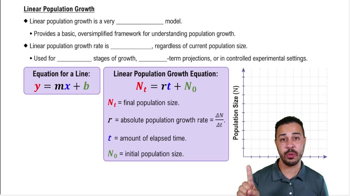
Linear Population Growth

Environmental Degradation

Environmental degradation is the deterioration of the environment through the depletion of resources, destruction of ecosystems, and pollution. In developing countries, rapid population growth can lead to deforestation, loss of biodiversity, and increased waste. In developed countries, environmental degradation often manifests through industrial pollution, urban sprawl, and high carbon emissions, despite lower population growth rates.
Recommended video:
Guided course
03:23
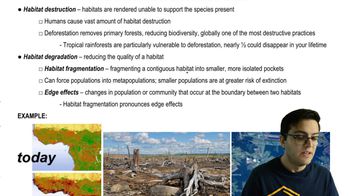
Habitat Destruction and Degradation

Sustainability

Sustainability is the ability to meet present needs without compromising the ability of future generations to meet their own needs. It encompasses environmental, social, and economic dimensions. Addressing population growth in both developing and developed countries requires sustainable practices that balance resource use and environmental protection, ensuring long-term viability for ecosystems and human societies.
Recommended video:
Guided course
05:06
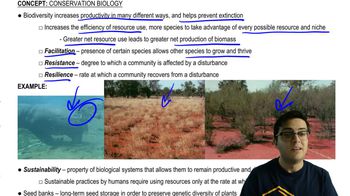
Biodiversity and Sustainability