Pearson+ LogoPearson+ Logo
Ch. 36 Population Ecology
Taylor - Campbell Biology: Concepts & Connections 10th Edition
Taylor, Simon, Dickey, Hogan10th EditionCampbell Biology: Concepts & ConnectionsISBN: 9780136538783Not the one you use?Change textbook
Chapter 36, Problem 1

Use this graph of the idealized exponential and logistic growth curves to complete the following.
a. Label the axes and curves on the graph.
b. Give the formula that describes the blue curve.
c. What does the dotted line represent?
d. For each curve, indicate and explain where population growth is the most rapid.
e. Which of these curves best represents global human population growth?
Graph showing exponential (blue) and logistic (red) growth curves with a dotted line.

Verified step by step guidance
1
Step 1: Label the axes on the graph. The x-axis represents time, while the y-axis represents population size. The blue curve represents exponential growth, and the red curve represents logistic growth.
Step 2: Provide the formula for the blue curve. Exponential growth is described by the formula G=rN, where G is the growth rate, r is the per capita rate of increase, and N is the population size.
Step 3: Explain the dotted line. The dotted line represents the carrying capacity (K), which is the maximum population size that the environment can sustain indefinitely given the available resources.
Step 4: Indicate where population growth is most rapid for each curve. For the exponential growth curve (blue), population growth is most rapid at the steepest part of the curve, as there are no limiting factors. For the logistic growth curve (red), population growth is most rapid at the midpoint of the curve, where the population size is half of the carrying capacity (K/2). This is because the growth rate slows as the population approaches the carrying capacity.
Step 5: Identify which curve best represents global human population growth. The blue curve (exponential growth) best represents global human population growth, as human populations have historically grown exponentially due to advances in technology, medicine, and agriculture, although some regions may begin to show logistic growth patterns as resources become limiting.

Verified video answer for a similar problem:

This video solution was recommended by our tutors as helpful for the problem above.
Video duration:
2m
Was this helpful?

Key Concepts

Here are the essential concepts you must grasp in order to answer the question correctly.

Exponential Growth

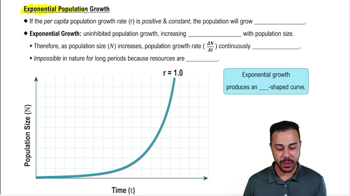
Exponential growth occurs when a population increases at a constant rate, resulting in a J-shaped curve. This type of growth is characterized by rapid population increase when resources are abundant, leading to a doubling effect over time. The formula for exponential growth is G = rN, where G is the growth rate, r is the intrinsic growth rate, and N is the current population size.
Recommended video:
Guided course
03:05
Exponential Population Growth

Logistic Growth

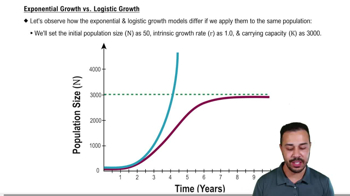
Logistic growth describes how a population grows rapidly at first but slows as it approaches the carrying capacity (K) of its environment, resulting in an S-shaped curve. The growth rate decreases as resources become limited, and the population stabilizes around the carrying capacity. The formula for logistic growth is G = rN(K - N)/K, which incorporates the effects of resource limitations.
Recommended video:
Guided course
09:46
Exponential Growth vs. Logistic Growth

Carrying Capacity

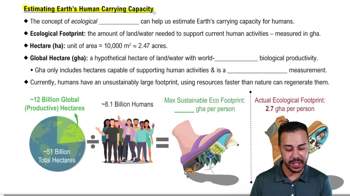
Carrying capacity (K) is the maximum population size that an environment can sustain indefinitely without degrading the habitat. It is represented by the dotted line in the graph, indicating the point at which population growth levels off in logistic growth. Understanding carrying capacity is crucial for predicting population dynamics and managing resources effectively.
Recommended video:
Guided course
06:24
Estimating Earth’s Human Carrying Capacity