
Pearson+ LogoPearson+ Logo
Ch. 27 Reproduction and Embryonic Development
Taylor - Campbell Biology: Concepts & Connections 10th Edition
Taylor, Simon, Dickey, Hogan10th EditionCampbell Biology: Concepts & ConnectionsISBN: 9780136538783Not the one you use?Change textbook
Chapter 27, Problem 13

A woman had several miscarriages. Her doctor suspected that a hormonal insufficiency was causing the lining of the uterus to break down, as it does during menstruation, terminating her pregnancies. Treatment with which of the following might help her remain pregnant?
a. Oxytocin
b. Follicle-stimulating hormone
c. Luteinizing hormone
d. Prolactin

Verified step by step guidance
1
Understand the role of the uterine lining in pregnancy: The uterine lining, also known as the endometrium, is essential for the implantation and nourishment of the embryo. If the lining breaks down prematurely, it can lead to miscarriage.
Identify the hormones involved in maintaining the uterine lining: Progesterone is the key hormone responsible for maintaining the uterine lining during pregnancy. It prevents the breakdown of the endometrium and supports early pregnancy.
Analyze the options provided: a) Oxytocin is involved in uterine contractions during labor and milk ejection, not in maintaining the uterine lining. b) Follicle-stimulating hormone (FSH) stimulates the growth of ovarian follicles but does not maintain the uterine lining. c) Luteinizing hormone (LH) triggers ovulation and the formation of the corpus luteum, which produces progesterone. d) Prolactin is primarily involved in milk production, not in maintaining the uterine lining.
Focus on the role of the corpus luteum: After ovulation, the corpus luteum forms and secretes progesterone. Luteinizing hormone (LH) is necessary for the formation and maintenance of the corpus luteum, which in turn produces the progesterone needed to sustain the uterine lining.
Conclude that treatment with luteinizing hormone (option c) might help the woman remain pregnant by supporting the corpus luteum and ensuring adequate progesterone levels to maintain the uterine lining.

Verified video answer for a similar problem:

This video solution was recommended by our tutors as helpful for the problem above.
Video duration:
1m
Was this helpful?

Key Concepts

Here are the essential concepts you must grasp in order to answer the question correctly.

Hormonal Regulation of Menstruation

The menstrual cycle is regulated by a complex interplay of hormones, including estrogen and progesterone. These hormones prepare the uterine lining for potential implantation of a fertilized egg. If hormonal levels are insufficient, the lining may break down prematurely, leading to miscarriage. Understanding this regulation is crucial for addressing issues related to pregnancy maintenance.
Recommended video:
Guided course
08:18
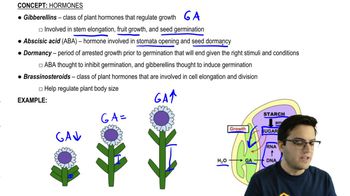
Plant Hormones and Senescence

Progesterone's Role in Pregnancy

Progesterone is a key hormone produced by the ovaries after ovulation, essential for maintaining the uterine lining during early pregnancy. It prevents the lining from shedding and supports embryo implantation. A deficiency in progesterone can lead to miscarriages, making it a critical focus in treatments aimed at sustaining pregnancies.
Recommended video:
Guided course
04:09
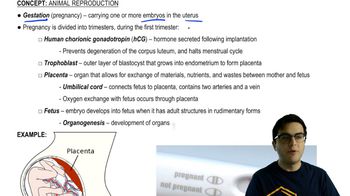
Pregnancy and Birth

Hormonal Treatments for Pregnancy Maintenance

Various hormonal treatments can be used to support pregnancy, particularly in cases of hormonal insufficiency. Medications like progesterone supplements can help stabilize the uterine lining. Understanding which hormones are involved and their specific roles is vital for selecting appropriate treatments to help women with recurrent miscarriages.
Recommended video:
Guided course
04:09
Pregnancy and Birth
Related Practice
Textbook Question

After a sperm penetrates an egg, it is important that the vitelline layer separate from the egg so that it can

a. Secrete important hormones.

b. Enable the fertilized egg to implant in the uterus.

c. Prevent more than one sperm from entering the egg.

d. Attract additional sperm to the egg.

1186
views
Textbook Question

In an experiment, a researcher colored a bit of tissue on the ­outside of a frog gastrula with an orange fluorescent dye. The embryo developed normally. When the tadpole was placed under an ultraviolet light, which of the following glowed bright orange? (Explain your answer.)

a. The heart

b. The pancreas

c. The brain

d. The stomach

845
views
Textbook Question

How does a zygote differ from a mature egg?

a. A zygote has more chromosomes.

b. A zygote is smaller.

c. A zygote consists of more than one cell.

d. A zygote divides by meiosis.

1374
views
Textbook Question
The embryos of reptiles (including birds) and mammals have systems of extraembryonic membranes. What are the functions of these membranes, and how do fish and frog embryos survive without them?
1133
views
Textbook Question
Compare sperm formation with egg formation. In what ways are the processes similar? In what ways are they different?
1310
views
Textbook Question
In an embryo, nerve cells grow out from the spinal cord and form connections with the muscles they will eventually control. What mechanisms described in this chapter might explain how these cells 'know' where to go and which cells to connect with?
1059
views