Pearson+ LogoPearson+ Logo
Ch. 29 The Senses
Taylor - Campbell Biology: Concepts & Connections 10th Edition
Taylor, Simon, Dickey, Hogan10th EditionCampbell Biology: Concepts & ConnectionsISBN: 9780136538783Not the one you use?Change textbook
Chapter 29, Problem 5

If you look away from this book and focus your eyes on a distant object, the eye muscles _________ and the lenses _________ to focus images on the retinas.
a. Relax . . . Flatten
b. Relax . . . Become more rounded
c. Contract . . . Flatten
d. Contract . . . Become more rounded

Verified step by step guidance
1
Understand the anatomy of the eye: The lens of the eye changes shape to focus light on the retina, a process called accommodation. The ciliary muscles control the shape of the lens.
Recognize the relationship between the ciliary muscles and the lens: When focusing on distant objects, the ciliary muscles relax, causing the lens to flatten. This allows light rays from distant objects to be properly focused on the retina.
Contrast this with focusing on nearby objects: When focusing on close objects, the ciliary muscles contract, making the lens more rounded to bend light rays more sharply.
Analyze the options provided: The correct answer must describe the relaxation of the ciliary muscles and the flattening of the lens when focusing on distant objects.
Select the correct answer based on the explanation: The correct choice is 'a. relax . . . flatten,' as this matches the physiological process of focusing on distant objects.

Verified video answer for a similar problem:

This video solution was recommended by our tutors as helpful for the problem above.
Video duration:
1m
Was this helpful?

Key Concepts

Here are the essential concepts you must grasp in order to answer the question correctly.

Accommodation

Accommodation is the process by which the eye adjusts its focus on objects at varying distances. When focusing on distant objects, the ciliary muscles relax, allowing the lens to flatten, which is essential for clear vision. This mechanism ensures that light rays from distant objects are properly focused onto the retina.

Ciliary Muscles

Ciliary muscles are small muscles located around the lens of the eye that control its shape. When these muscles contract, they cause the lens to become more rounded for near vision. Conversely, when they relax, the lens flattens, which is necessary for focusing on distant objects.
Recommended video:
Guided course
02:08
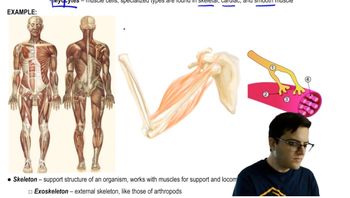
Muscle System and Skeleton

Lens Shape and Light Refraction

The shape of the lens affects how light is refracted, or bent, as it enters the eye. A rounded lens increases the refractive power, allowing for better focus on nearby objects, while a flattened lens decreases refractive power, which is optimal for distant vision. This adjustment is crucial for maintaining clear vision across different distances.
Recommended video:
Guided course
15:15
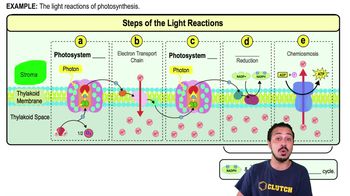
Steps of the Light Reactions
Related Practice
Textbook Question

Which of the following sensory receptors is incorrectly paired with its category?

a. Hair cell . . . Mechanoreceptor

b. Taste receptor . . . Chemoreceptor

c. Rod . . . Electromagnetic receptor

d. Olfactory receptor . . . Electromagnetic receptor

1073
views
Textbook Question

Which of the following are not known to be present in human skin?

a. Thermoreceptors

b. Electromagnetic receptors

c. Pressure receptors

d. Pain receptors

1126
views
Textbook Question

What do the receptor cells in the lateral line system along the sides of a shark and the cochlea of your ear have in common?

a. They use hair cells to sense sound or pressure waves.

b. They are organs of equilibrium.

c. They use electromagnetic receptors to sense pressure waves in fluid.

d. They use granules that signal a change in position and stimulate their receptor cells.

1381
views
Textbook Question
How does your brain determine the volume and pitch of sounds?
1458
views
Textbook Question

Eighty-year-old Mr. Johnson was becoming slightly deaf. To test his hearing, his doctor held a vibrating tuning fork tightly against the back of Mr. Johnson's skull. This sent vibrations through the bones of the skull, setting the fluid in the cochlea in motion. Mr. Johnson could hear the tuning fork this way, but not when it was held away from the skull a few inches from his ear. The problem was probably in the _________ . (Explain your answer.)

a. Auditory nerve leading to the brain

b. Hair cells in the cochlea

c. Bones of the middle ear

d. Fluid of the cochlea

754
views
Textbook Question
When you first sit down to read in a coffee shop, the surroundings seem very loud. Yet after a few minutes reading you realize you hardly notice the noise at all. Why is that?
771
views