Pearson+ LogoPearson+ Logo
Ch. 29 The Senses
Taylor - Campbell Biology: Concepts & Connections 10th Edition
Taylor, Simon, Dickey, Hogan10th EditionCampbell Biology: Concepts & ConnectionsISBN: 9780136538783Not the one you use?Change textbook
Chapter 29, Problem 8

When you first sit down to read in a coffee shop, the surroundings seem very loud. Yet after a few minutes reading you realize you hardly notice the noise at all. Why is that?

Verified step by step guidance
1
Identify the biological concept involved: This scenario involves a concept known as 'sensory adaptation' which is a change over time in the responsiveness of the sensory system to a constant stimulus.
Understand the mechanism: Sensory adaptation occurs when sensory receptors change their sensitivity to the stimulus. In this case, the receptors in your ears (auditory receptors) are initially sensitive to the noise level in the coffee shop.
Recognize the response of the nervous system: As you continue to stay in the noisy environment, the neurons in the auditory pathway reduce their firing rate. This means that over time, they send fewer signals to the brain about the noise.
Realize the perceptual change: Due to the decreased firing rate of neurons, the brain perceives the noise as less bothersome or noticeable, allowing you to focus more on your reading without being distracted by the surrounding sounds.
Apply the concept broadly: Sensory adaptation is not limited to auditory senses but also applies to other senses like smell, touch, and sight, helping organisms to adapt to constant stimuli in their environments.

Verified video answer for a similar problem:

This video solution was recommended by our tutors as helpful for the problem above.
Video duration:
2m
Was this helpful?

Key Concepts

Here are the essential concepts you must grasp in order to answer the question correctly.

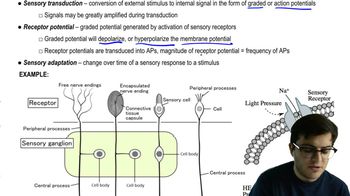
Sensory Adaptation

Sensory adaptation is the process by which our sensory receptors become less sensitive to constant stimuli over time. In the context of the coffee shop, the initial loudness of the environment captures your attention, but as you continue to read, your brain begins to filter out the background noise, allowing you to focus on your reading.
Recommended video:
Guided course
06:25
Sensory Systems

Selective Attention

Selective attention refers to the cognitive process of focusing on specific stimuli while ignoring others. When you first enter the coffee shop, your attention is drawn to the noise, but as you engage with your reading material, your brain prioritizes the text, effectively tuning out the distracting sounds around you.
Recommended video:
04:43
Natural Selection

Habituation

Habituation is a form of learning in which an organism decreases its response to a stimulus after repeated exposure. In this scenario, as you become accustomed to the coffee shop's noise, your brain learns to disregard it, leading to a diminished awareness of the sounds as you immerse yourself in reading.
Recommended video:
02:46
Allopatric and Sympatric Speciation
Related Practice
Textbook Question

If you look away from this book and focus your eyes on a distant object, the eye muscles _________ and the lenses _________ to focus images on the retinas.

a. Relax . . . Flatten

b. Relax . . . Become more rounded

c. Contract . . . Flatten

d. Contract . . . Become more rounded

834
views
Textbook Question
How does your brain determine the volume and pitch of sounds?
1458
views
Textbook Question

Eighty-year-old Mr. Johnson was becoming slightly deaf. To test his hearing, his doctor held a vibrating tuning fork tightly against the back of Mr. Johnson's skull. This sent vibrations through the bones of the skull, setting the fluid in the cochlea in motion. Mr. Johnson could hear the tuning fork this way, but not when it was held away from the skull a few inches from his ear. The problem was probably in the _________ . (Explain your answer.)

a. Auditory nerve leading to the brain

b. Hair cells in the cochlea

c. Bones of the middle ear

d. Fluid of the cochlea

754
views
Textbook Question
Hold your right eye closed. With your left eye, look at the + in the image below. Starting from about two feet away, slowly bring your head closer while looking at the +. What happens to the dot when you get close to the image? What property of the eye's structure does this exercise demonstrate?

659
views
Textbook Question
Construct a graph in which membrane potential is on the y axis and time is on the x axis. Then draw the action potentials that occur when a bitter flavor is absent, followed by the action potentials that result when a person tastes a bitter flavor.
872
views
Textbook Question

We know that sea turtle hatchlings use Earth's magnetic field to navigate. Do they also use light cues from the moon to get from the sand to the ocean waves? Outline an experiment to answer this question.

851
views