
Pearson+ LogoPearson+ Logo
Ch. 19 The Evolution of Vertebrate Diversity
Taylor - Campbell Biology: Concepts & Connections 10th Edition
Taylor, Simon, Dickey, Hogan10th EditionCampbell Biology: Concepts & ConnectionsISBN: 9780136538783Not the one you use?Change textbook
Chapter 19, Problem 7

Which of these is not a member of the anthropoids?
a. Chimpanzee
b. Tarsier
c. Human
d. New World monkey

Verified step by step guidance
1
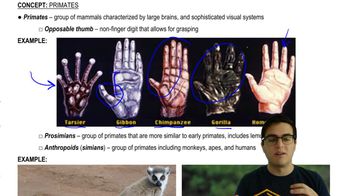
Step 1: Understand the term 'anthropoids'. Anthropoids are a group of primates that include monkeys, apes, and humans. They are characterized by larger brains, forward-facing eyes, and more complex social behaviors compared to other primates.
Step 2: Review the options provided in the question: chimpanzee, tarsier, human, and New World monkey. Determine which of these fits the definition of anthropoids.
Step 3: Recall that chimpanzees, humans, and New World monkeys are all classified as anthropoids. Chimpanzees and humans are part of the ape subgroup, while New World monkeys belong to the monkey subgroup.
Step 4: Note that tarsiers are not classified as anthropoids. Instead, they belong to a different group of primates called prosimians, which are more primitive and include species like lemurs and lorises.
Step 5: Conclude that the correct answer is the option that does not belong to the anthropoids group, which is the tarsier.

Verified video answer for a similar problem:

This video solution was recommended by our tutors as helpful for the problem above.
Video duration:
44s
Was this helpful?

Key Concepts

Here are the essential concepts you must grasp in order to answer the question correctly.

Anthropoids

Anthropoids are a suborder of primates that includes monkeys, apes, and humans. They are characterized by larger brains, forward-facing eyes, and a more complex social structure compared to other primates. This group is divided into two main categories: Platyrrhines (New World monkeys) and Catarrhines (Old World monkeys and apes). Understanding the classification of anthropoids is essential for identifying which species belong to this group.
Recommended video:

Tarsiers

Tarsiers are small primates found in Southeast Asia, classified under the infraorder Tarsiiformes. Unlike anthropoids, tarsiers have distinct features such as large eyes adapted for nocturnal vision and a unique ankle bone structure that allows for powerful leaping. They are considered prosimians, which are more primitive primates, highlighting the evolutionary distinction between them and anthropoids.
Recommended video:

Primate Classification

Primate classification is a hierarchical system that categorizes primates based on shared characteristics and evolutionary relationships. It includes two main suborders: Strepsirrhini (lemurs and lorises) and Haplorhini (tarsiers and anthropoids). Understanding this classification helps in identifying which species belong to which group, aiding in the recognition of members of the anthropoid group in the context of the question.
Recommended video:
Related Practice
Textbook Question

Why were the Tiktaalik fossils an exciting discovery for scientists studying tetrapod evolution?

a. They are the earliest frog-like animal discovered to date.

b. They show that tetrapods successfully colonized land much earlier than previously thought.

c. They have a roughly equal combination of fishlike and tetrapod-like characteristics.

d. They demonstrate conclusively that limbs evolved as lobe-fins dragged themselves from pond to pond during droughts.

1781
views
Textbook Question

Fossils suggest that the first major trait distinguishing hominins from other primates was

a. A larger brain.

b. Erect posture.

c. Forward-facing eyes with depth perception.

d. Tool making.

1017
views
Textbook Question

Which of the following correctly lists possible ancestors of humans from the oldest to the most recent?

a. Homo erectus, Australopithecus, Homo habilis

b. Australopithecus, Homo habilis, Homo erectus

c. Australopithecus, Homo erectus, Homo habilis

d. Homo ergaster, Homo erectus, Homo neanderthalensis

832
views
Textbook Question

Studies of DNA support which of the following?

a. Members of the group called australopiths were the first to migrate from Africa.

b. Homo sapiens originated in Africa.

c. Sahelanthropus was the earliest hominin.

d. Chimpanzees are more similar to gorillas and orangutans than to humans.

762
views
Textbook Question

The earliest members of the genus Homo

a. Had a larger brain compared to other hominins.

b. Probably hunted dinosaurs.

c. Lived about 4 million years ago.

d. Were the first hominins to be bipedal.

1353
views
Textbook Question
Compare the adaptations of amphibians and reptiles for terrestrial life.
1192
views