Pearson+ LogoPearson+ Logo
Ch. 11 - Cell-Cell Interactions
Freeman - Biological Science 7th Edition
Freeman7th EditionBiological ScienceISBN: 9783584863285Not the one you use?Change textbook
Chapter 11, Problem 4

What does it mean to say that a signal is transduced?
a. The signaling molecule enters the cell directly and elicits a cellular response.
b. The signal is generated by the production of proteins.
c. The physical form of the signal changes between the outside of the cell and the inside.
d. The signal is amplified.

Verified step by step guidance
1
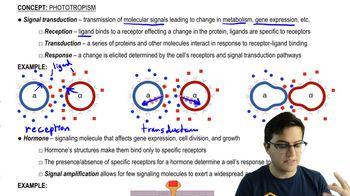
Understand the concept of signal transduction: Signal transduction refers to the process by which a cell converts an external signal into a functional response. This often involves a series of molecular events, including changes in the physical form of the signal.
Identify the key components of signal transduction: Typically, signal transduction involves receptors on the cell surface that detect signaling molecules, leading to a cascade of intracellular events.
Consider how the signal changes: In signal transduction, the physical form of the signal often changes as it moves from outside the cell to inside. This can involve the activation of secondary messengers or other molecular changes.
Evaluate the options given: Option c states that the physical form of the signal changes between the outside of the cell and the inside, which aligns with the concept of signal transduction.
Conclude which option best describes signal transduction: Based on the understanding of signal transduction, option c is the most accurate description of what it means for a signal to be transduced.

Verified video answer for a similar problem:

This video solution was recommended by our tutors as helpful for the problem above.
Video duration:
2m
Was this helpful?

Key Concepts

Here are the essential concepts you must grasp in order to answer the question correctly.

Signal Transduction

Signal transduction refers to the process by which a cell converts an external signal into a functional response. This involves a series of molecular events, often including the activation of proteins and second messengers, that lead to changes in cellular activity. The signal's physical form may change as it is relayed from the cell surface to the interior.
Recommended video:
Guided course
06:56
Signal Transduction and Response

Cellular Response

A cellular response is the outcome of signal transduction, where the cell reacts to a signal by altering its behavior or function. This can include changes in gene expression, enzyme activity, or cell movement. The response is specific to the type of signal received and the pathways activated within the cell.
Recommended video:
Guided course
03:39
Introduction to Cellular Respiration

Signal Amplification

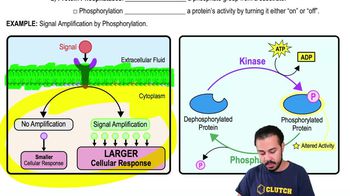
Signal amplification is a process within signal transduction where the initial signal is strengthened, allowing a small number of signaling molecules to produce a large cellular response. This is achieved through cascades of enzymatic reactions, where each step amplifies the signal, ensuring an effective and robust response to external stimuli.
Recommended video:
Guided course
06:10
Signal Amplification
Related Practice
Textbook Question

Where are protein components of the extracellular matrix synthesized?

a. In the rough ER

b. In the Golgi apparatus

c. In the plasma membrane

d. In the extracellular layer itself

2359
views
Textbook Question

Which of the following actions correctly describe a role performed by at least one type of intercellular connection? Select True or False for each statement.

T/FAllows communication between adjacent cells.

T/FForms a watertight barrier between the cells.

T/FUses components of the extracellular matrix to indirectly connect adjacent cells.

T/FAssociates with cytoskeletal components to resist pulling forces.

882
views
Textbook Question

How do the extracellular filaments in plants differ from those in animals?

a. Plant filaments resist compression forces; animal filaments resist pulling forces.

b. Animal filaments consist of proteins; plant filaments consist of polysaccharides.

c. Plant extracellular filaments never move; animal filaments can slide past one another.

d. Plant filaments run parallel to one another; animal filaments crisscross.

1973
views
Textbook Question

Summarize the experimental evidence in sponges showing that animal cells adhere to each other selectively. Explain the molecular basis of selective adhesion.

902
views
Textbook Question

Suppose you were to model amplification by the phosphorylation cascade in Figure 11.16, using a penny for each kinase 1, a nickel for each kinase 2, and a dime for each kinase 3. Also suppose that Ras and each of the kinases can activate 10 proteins. How much money would you need to construct your model?

647
views