Pearson+ LogoPearson+ Logo
Ch. 12 - The Cell Cycle
Freeman - Biological Science 7th Edition
Freeman7th EditionBiological ScienceISBN: 9783584863285Not the one you use?Change textbook
Chapter 12, Problem 7

The following statements are about the control of chromatin condensation. Select True or False for each.T/F Reducing histone acetylase activity is likely to decrease gene transcription.T/F Mutations that reduce the number of positively charged amino acids on histones should promote open chromatin.T/F Chromatin remodeling complexes add chemical groups to histones.T/F Adding an inhibitor of DNA methylation is likely to reduce gene transcription.

Verified step by step guidance
1
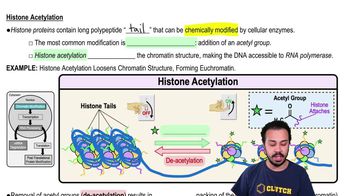
Identify the role of histone acetylase in chromatin structure: Histone acetylase enzymes add acetyl groups to histones, which reduces the positive charge on histones, leading to a less compact chromatin structure and promoting gene transcription.
Analyze the effect of mutations on histone charge: Understand that histones are positively charged due to the presence of amino acids like lysine and arginine. Mutations that reduce these positively charged amino acids would decrease the histone's ability to bind tightly with the negatively charged DNA, potentially leading to a more open chromatin structure.
Understand the function of chromatin remodeling complexes: Chromatin remodeling complexes are responsible for changing the position of DNA wrapped around histones. They do not typically add chemical groups to histones; instead, they physically move the nucleosomes to make certain areas of DNA more accessible for transcription.
Examine the role of DNA methylation in gene transcription: DNA methylation typically acts to repress gene transcription by adding methyl groups to DNA, particularly at cytosine bases. This modification generally leads to a more closed chromatin structure, inhibiting the binding of transcription machinery to the DNA.

Verified video answer for a similar problem:

This video solution was recommended by our tutors as helpful for the problem above.
Video duration:
35s
Was this helpful?

Key Concepts

Here are the essential concepts you must grasp in order to answer the question correctly.

Histone Acetylation and Gene Transcription

Histone acetylation is a process where acetyl groups are added to histone proteins, leading to a more relaxed chromatin structure. This relaxation allows for easier access of transcription machinery to DNA, thereby promoting gene transcription. Conversely, reducing histone acetylase activity would likely result in increased histone acetylation, leading to tighter chromatin and decreased transcription.
Recommended video:
Guided course
04:14
Histone Acetylation

Histone Charge and Chromatin Structure

Histones are positively charged proteins that bind to negatively charged DNA, helping to package it into chromatin. Mutations that reduce the number of positively charged amino acids on histones can weaken this interaction, promoting a more open chromatin structure. Open chromatin is associated with active transcription, as it allows easier access for transcription factors and RNA polymerase.
Recommended video:
Guided course
04:14
Histone Acetylation

Chromatin Remodeling Complexes

Chromatin remodeling complexes are multi-protein assemblies that alter the structure of chromatin, facilitating access to DNA. They do not add chemical groups to histones; instead, they reposition or evict nucleosomes to expose DNA regions for transcription. This process is crucial for regulating gene expression and is distinct from the addition of chemical modifications like methylation or acetylation.
Recommended video:
06:15
Origin of Complex Traits