The smooth feathers on the back of the neck in pigeons can be reversed by a mutation to produce a 'crested' appearance in which feathers form a distinctive spike at the back of the head. A pigeon breeder examined offspring produced by a single pair of non-crested birds and recorded the following: 22 non-crested and 7 crested. She then made a series of crosses using offspring from the first cross. When she crossed two of the crested birds, all 20 of the offspring were crested. When she crossed a non-crested bird with a crested bird, 7 offspring were non-crested and 6 were crested. For these three crosses, provide genotypes for parents and offspring that are consistent with these results.
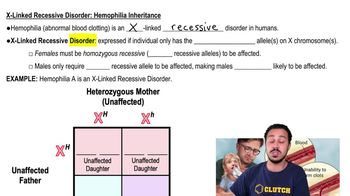
As a genetic counselor, you advise couples about the possibility of genetic disease in their offspring. Today you met with an engaged couple, both of whom are phenotypically normal. The man, however, has a brother who died of Duchenne-type muscular dystrophy, an X-linked recessive condition. His fiancée, whose family has no history of the disease, is worried that the couple's sons or daughters might be afflicted. The sister of this man is planning to marry his fiancée's brother. How would you advise this second couple?
Verified step by step guidance
Verified video answer for a similar problem:
Key Concepts
X-linked Recessive Inheritance
Carrier Status
Genetic Counseling
The smooth feathers on the back of the neck in pigeons can be reversed by a mutation to produce a 'crested' appearance in which feathers form a distinctive spike at the back of the head. A pigeon breeder examined offspring produced by a single pair of non-crested birds and recorded the following: 22 non-crested and 7 crested. She then made a series of crosses using offspring from the first cross. When she crossed two of the crested birds, all 20 of the offspring were crested. When she crossed a non-crested bird with a crested bird, 7 offspring were non-crested and 6 were crested. Which allele is dominant?
As a genetic counselor, you advise couples about the possibility of genetic disease in their offspring. Today you met with an engaged couple, both of whom are phenotypically normal. The man, however, has a brother who died of Duchenne-type muscular dystrophy, an X-linked recessive condition. His fiancée, whose family has no history of the disease, is worried that the couple's sons or daughters might be afflicted. How would you advise this couple?
Suppose you are heterozygous for two genes that are located on different chromosomes. You carry alleles A and a for one gene and alleles B and b for the other. Draw a diagram illustrating what happens to these genes and alleles when meiosis occurs in your reproductive tissues.
