Pearson+ LogoPearson+ Logo
Ch. 14 - Mendel and the Gene
Freeman - Biological Science 7th Edition
Freeman7th EditionBiological ScienceISBN: 9783584863285Not the one you use?Change textbook
Chapter 14, Problem 12

Suppose you are heterozygous for two genes that are located on different chromosomes. You carry alleles A and a for one gene and alleles B and b for the other. Label the stages of meiosis, the homologous chromosomes, sister chromatids, nonhomologous chromosomes, genes, and alleles.

Verified step by step guidance
1
Identify the stages of meiosis: Meiosis consists of two main stages, Meiosis I and Meiosis II. Each stage is further divided into phases: Prophase, Metaphase, Anaphase, and Telophase.
Label the homologous chromosomes: Homologous chromosomes are pairs of chromosomes that contain the same genes but may have different alleles. In this case, one pair will have the genes for alleles A and a, and another pair will have the genes for alleles B and b.
Distinguish sister chromatids: Sister chromatids are identical copies of a chromosome connected by a centromere. They are formed during the S phase of interphase and are visible from Prophase II of Meiosis.
Identify nonhomologous chromosomes: Nonhomologous chromosomes are chromosomes that do not pair during meiosis. In this scenario, the chromosomes carrying alleles A and a are nonhomologous to those carrying alleles B and b.
Locate genes and alleles: Genes are specific sequences of DNA on a chromosome that code for a particular protein. Alleles are different versions of the same gene. In this case, locate gene A on one chromosome and gene a on its homologous partner; similarly, locate gene B on another chromosome and gene b on its corresponding homologous partner.

Verified video answer for a similar problem:

This video solution was recommended by our tutors as helpful for the problem above.
Video duration:
1m
Was this helpful?

Key Concepts

Here are the essential concepts you must grasp in order to answer the question correctly.

Meiosis

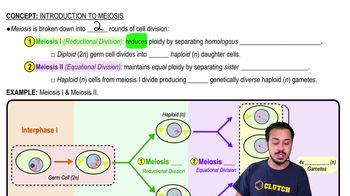
Meiosis is a specialized type of cell division that reduces the chromosome number by half, resulting in four genetically diverse gametes. It consists of two sequential divisions: meiosis I, where homologous chromosomes are separated, and meiosis II, where sister chromatids are separated. This process is crucial for sexual reproduction and contributes to genetic variation through independent assortment and crossing over.
Recommended video:
Guided course
04:49
Meiosis I & Meiosis II

Homologous Chromosomes

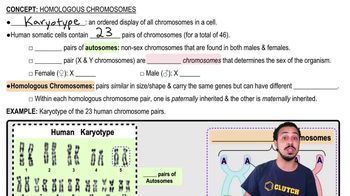
Homologous chromosomes are pairs of chromosomes that have the same structure and carry genes for the same traits, but may have different alleles. One chromosome of each pair is inherited from each parent. During meiosis, homologous chromosomes undergo pairing and recombination, which is essential for genetic diversity in offspring.
Recommended video:
Guided course
08:09
Homologous Chromosomes

Alleles

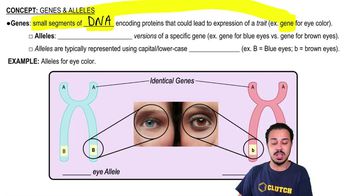
Alleles are different versions of a gene that arise by mutation and are found at the same locus on homologous chromosomes. In the context of the question, alleles A and a represent two variations of one gene, while B and b represent variations of another gene. The combination of alleles an individual carries (genotype) determines their traits (phenotype) and plays a significant role in inheritance patterns.
Recommended video:
Guided course
05:02
Genes & Alleles
Related Practice
Textbook Question

As a genetic counselor, you advise couples about the possibility of genetic disease in their offspring. Today you met with an engaged couple, both of whom are phenotypically normal. The man, however, has a brother who died of Duchenne-type muscular dystrophy, an X-linked recessive condition. His fiancée, whose family has no history of the disease, is worried that the couple's sons or daughters might be afflicted. How would you advise this couple?

1112
views
Textbook Question

As a genetic counselor, you advise couples about the possibility of genetic disease in their offspring. Today you met with an engaged couple, both of whom are phenotypically normal. The man, however, has a brother who died of Duchenne-type muscular dystrophy, an X-linked recessive condition. His fiancée, whose family has no history of the disease, is worried that the couple's sons or daughters might be afflicted. The sister of this man is planning to marry his fiancée's brother. How would you advise this second couple?

958
views
Textbook Question
Suppose you are heterozygous for two genes that are located on different chromosomes. You carry alleles A and a for one gene and alleles B and b for the other. Draw a diagram illustrating what happens to these genes and alleles when meiosis occurs in your reproductive tissues.
971
views
Textbook Question

Suppose you are heterozygous for two genes that are located on different chromosomes. You carry alleles A and a for one gene and alleles B and b for the other. Draw a diagram illustrating what happens to these genes and alleles when meiosis occurs in your reproductive tissues.

1163
views
Textbook Question

Suppose you are heterozygous for two genes that are located on different chromosomes. You carry alleles A and a for one gene and alleles B and b for the other. Label the stages of meiosis, the homologous chromosomes, sister chromatids, nonhomologous chromosomes, genes, and alleles.

913
views
Textbook Question

Suppose you are heterozygous for two genes that are located on different chromosomes. You carry alleles A and a for one gene and alleles B and b for the other. Be sure to list all the genetically different gametes that could form and indicate how frequently each type should be observed.

868
views