Pearson+ LogoPearson+ Logo
Ch. 15 - DNA and the Gene: Synthesis and Repair
Freeman - Biological Science 7th Edition
Freeman7th EditionBiological ScienceISBN: 9783584863285Not the one you use?Change textbook
Chapter 15, Problem 6

Analyze the following statements about DNA synthesis. Select True or False for each statement.
T/FAn RNA polymerase is essential for DNA synthesis.
T/FOkazaki fragments would be unnecessary if DNA polymerase could synthesize DNA in both the 3'→5' and 5'→3' directions.
T/FDNA ligase is used more frequently on the lagging strand than on the leading strand.
T/FToposiomerase is required to separate the two strands of DNA at the replication fork.

Verified step by step guidance
1
Understand the role of RNA polymerase: RNA polymerase is primarily involved in the synthesis of RNA from a DNA template during transcription, not DNA synthesis. DNA synthesis requires DNA polymerase, not RNA polymerase.
Consider the directionality of DNA synthesis: DNA polymerase synthesizes DNA only in the 5' to 3' direction. Okazaki fragments are short sequences synthesized on the lagging strand because DNA polymerase cannot synthesize in the 3' to 5' direction. If DNA polymerase could synthesize in both directions, Okazaki fragments would not be necessary.
Examine the function of DNA ligase: DNA ligase is an enzyme that joins DNA fragments together. On the lagging strand, multiple Okazaki fragments are synthesized, requiring DNA ligase to join them. The leading strand is synthesized continuously, so DNA ligase is used less frequently.
Clarify the role of topoisomerase: Topoisomerase helps relieve the tension in the DNA helix during replication but does not separate the strands. Helicase is the enzyme responsible for unwinding and separating the two strands at the replication fork.
Review each statement based on the explanations provided: Use the understanding of each enzyme's role and the process of DNA synthesis to determine the truthfulness of each statement.

Verified video answer for a similar problem:

This video solution was recommended by our tutors as helpful for the problem above.
Video duration:
1m
Was this helpful?

Key Concepts

Here are the essential concepts you must grasp in order to answer the question correctly.

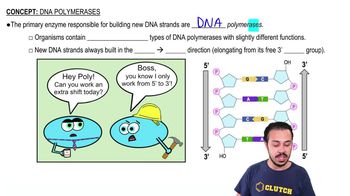
DNA Polymerase Directionality

DNA polymerase synthesizes DNA in the 5' to 3' direction, which is crucial for understanding why Okazaki fragments are formed. On the lagging strand, DNA polymerase must work in short segments, creating Okazaki fragments, because it cannot synthesize in the 3' to 5' direction. This limitation necessitates the discontinuous synthesis of DNA on the lagging strand.
Recommended video:
Guided course
04:01
DNA Polymerases

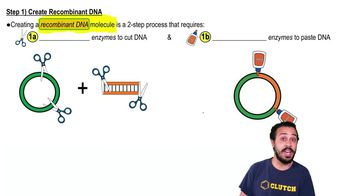
Role of DNA Ligase

DNA ligase is an enzyme that joins DNA fragments together by forming phosphodiester bonds. It is used more frequently on the lagging strand during DNA replication because it is responsible for connecting the Okazaki fragments into a continuous strand. On the leading strand, DNA synthesis is continuous, requiring less frequent use of DNA ligase.
Recommended video:
Guided course
02:09
Step 1) Create Recombinant DNA

Function of Topoisomerase

Topoisomerase is an enzyme that helps relieve the tension in the DNA helix ahead of the replication fork by cutting, unwinding, and rejoining DNA strands. It is not directly involved in separating the two strands of DNA; this task is performed by helicase. Topoisomerase ensures that the DNA does not become overly coiled or tangled during replication.
Recommended video:
Guided course
06:04
Functional Groups