Pearson+ LogoPearson+ Logo
Ch. 22 - Evolution by Natural Selection
Freeman - Biological Science 7th Edition
Freeman7th EditionBiological ScienceISBN: 9783584863285Not the one you use?Change textbook
Chapter 22, Problem 5

Explain the logic behind the claim that the nuclear envelope is a synapomorphy that defines eukaryotes as a monophyletic group.

Verified step by step guidance
1
Understand the definition of synapomorphy: A synapomorphy is a characteristic or feature that is shared by two or more taxa and is derived through evolution from a common ancestral form. In this context, it is a trait that is present in an ancestor and all its descendants, distinguishing them from other organisms.
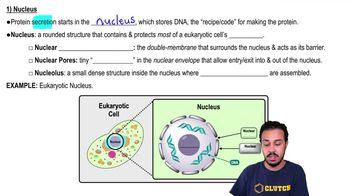
Identify the structure in question: The nuclear envelope is a double membrane structure that encloses the nucleus in eukaryotic cells. It separates the genetic material from the cytoplasm and regulates the flow of molecules in and out of the nucleus.
Recognize the uniqueness of the nuclear envelope: The nuclear envelope is unique to eukaryotic cells and is not found in prokaryotic cells (bacteria and archaea), which have no nucleus and instead have their genetic material freely floating in the cytoplasm.
Connect the nuclear envelope to eukaryotic identity: Since all eukaryotic cells, from single-celled organisms to cells in multicellular organisms like plants and animals, possess a nuclear envelope, it serves as a distinguishing feature that sets them apart from prokaryotes.
Conclude its role as a synapomorphy: The presence of the nuclear envelope in all eukaryotic cells and its absence in prokaryotic cells supports the claim that the nuclear envelope is a synapomorphy. This feature supports the classification of eukaryotes as a monophyletic group, meaning all members of this group are descended from a common ancestor that originally evolved this trait.

Verified video answer for a similar problem:

This video solution was recommended by our tutors as helpful for the problem above.
Video duration:
1m
Was this helpful?

Key Concepts

Here are the essential concepts you must grasp in order to answer the question correctly.

Nuclear Envelope

The nuclear envelope is a double membrane structure that surrounds the nucleus in eukaryotic cells. It serves to separate the genetic material from the cytoplasm, providing a controlled environment for DNA replication and transcription. This compartmentalization is a key feature distinguishing eukaryotes from prokaryotes, which lack such a structure.
Recommended video:

Synapomorphy

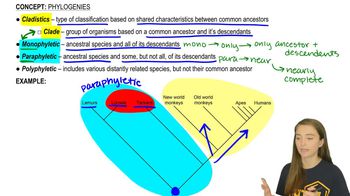
A synapomorphy is a shared derived characteristic that is used to define a group of organisms in phylogenetics. It indicates a trait that is present in an ancestor and all its descendants, helping to establish evolutionary relationships. The nuclear envelope is considered a synapomorphy for eukaryotes because it is a defining feature that all eukaryotic organisms share, indicating their common ancestry.
Recommended video:

Monophyletic Group

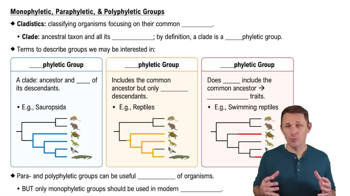
A monophyletic group, or clade, consists of an ancestor and all its descendants, representing a complete branch on the tree of life. This concept is crucial for understanding evolutionary relationships, as it ensures that all members of the group share a common lineage. The classification of eukaryotes as a monophyletic group is supported by the presence of the nuclear envelope, which is a unique trait that unites all eukaryotic organisms.
Recommended video:
06:37
Monophyletic, Paraphyletic, & Polyphyletic Group
Related Practice
Textbook Question
Traits that are derived from a common ancestor, like the bones of human arms and bird wings, are said to be .
936
views
Textbook Question

How can evolutionary fitness be measured? Select True or False for each statement.

T/F Document how long individuals survive.

T/F Count the number of healthy, fertile offspring produced.

T/F Determine which individuals are strongest.

T/F Determine which phenotype is the most common.

1257
views
Textbook Question

According to data presented in this chapter, which of the following are correct? Select True or False for each statement. T/F When individuals change in response to challenges from the environment, their altered traits are passed on to offspring. T/F Species are created independently of each other and do not change over time. T/F Populations—not individuals—change when natural selection occurs. T/F The traits of populations become more perfect over time.

695
views
Textbook Question

Some biologists summarize evolution by natural selection with the phrase "mutation proposes, selection disposes." Mutation is a process that creates heritable variation. Explain what the phrase means.

897
views
Textbook Question

Why don't the biggest and strongest individuals in a population always produce the most offspring?

a. The biggest and strongest individuals always have higher fitness.

b. In some environments, being big and strong lowers fitness.

c. Sometimes the biggest and strongest individuals may choose to have fewer offspring.

d. Sometimes the number of offspring is not related to fitness.

1007
views
Textbook Question
Explain why the overprescription of antibiotics by doctors, or the overuse of everyday soaps containing antibiotics, can be a health risk.
1097
views