Pearson+ LogoPearson+ Logo
Ch. 22 - Evolution by Natural Selection
Freeman - Biological Science 7th Edition
Freeman7th EditionBiological ScienceISBN: 9783584863285Not the one you use?Change textbook
Chapter 22, Problem 3

Traits that are derived from a common ancestor, like the bones of human arms and bird wings, are said to be .

Verified step by step guidance
1
Identify the concept being described: The question refers to traits in different species that have a similar structure due to inheritance from a common ancestor.
Recognize the term that fits the description: The concept being described is a fundamental aspect of evolutionary biology, focusing on how certain structures are retained through evolutionary history.
Connect the concept to the correct biological term: The term that describes traits inherited from a common ancestor that appear in different species is known as 'homologous'.
Apply the term to the example given: In the context of the example, the bones in human arms and bird wings are homologous structures because they have evolved from the same ancestral source, despite their different functions in each species.
Conclude with the definition: Homologous traits are those that are similar in different organisms because they were inherited from a common ancestor, which can be identified by their similar structure and embryonic origin.

Verified video answer for a similar problem:

This video solution was recommended by our tutors as helpful for the problem above.
Video duration:
3m
Was this helpful?

Key Concepts

Here are the essential concepts you must grasp in order to answer the question correctly.

Homologous Structures

Homologous structures are anatomical features in different species that share a common ancestry, even if their functions differ. For example, the forelimbs of humans and the wings of birds have similar bone structures, indicating they evolved from a common ancestor. This concept highlights evolutionary relationships and the divergence of species over time.
Recommended video:
Guided course
08:09
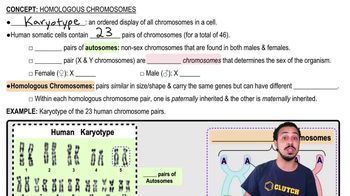
Homologous Chromosomes

Evolutionary Biology

Evolutionary biology is the study of the processes that drive the evolution of species over time. It encompasses concepts such as natural selection, genetic drift, and common descent. Understanding evolutionary biology is crucial for interpreting how homologous structures arise and how they reflect the shared ancestry of different organisms.
Recommended video:
02:45
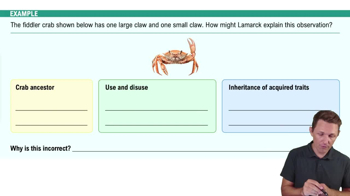
History of Evolutionary Theory Example 1

Phylogenetics

Phylogenetics is the branch of biology that deals with the evolutionary relationships among species. It uses various data, including morphological and genetic information, to construct evolutionary trees or cladograms. This concept is essential for understanding how homologous structures can indicate common ancestry and the evolutionary pathways that lead to the diversity of life.
Recommended video:
04:13
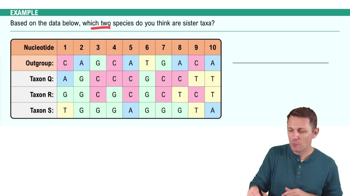
Building Phylogenetic Trees Example 2
Related Practice
Textbook Question

True or false? Some traits are considered vestigial because they existed long ago.

1187
views
Textbook Question

Why does the presence of extinct forms and transitional features in the fossil record support the pattern component of the theory of evolution by natural selection? Select True or False for each statement.

T/F It supports the hypothesis that individuals change over time.

T/F It supports the hypothesis that weaker species are eliminated by natural selection.

T/F It supports the hypothesis that species evolve to become more complex and better adapted over time.

T/F It supports the hypothesis that species change over time.

701
views
Textbook Question

Traits that are derived from a common ancestor, like the bones of human arms and bird wings, are said to be               .

1147
views
Textbook Question

How can evolutionary fitness be measured? Select True or False for each statement.

T/F Document how long individuals survive.

T/F Count the number of healthy, fertile offspring produced.

T/F Determine which individuals are strongest.

T/F Determine which phenotype is the most common.

1257
views
Textbook Question

According to data presented in this chapter, which of the following are correct? Select True or False for each statement. T/F When individuals change in response to challenges from the environment, their altered traits are passed on to offspring. T/F Species are created independently of each other and do not change over time. T/F Populations—not individuals—change when natural selection occurs. T/F The traits of populations become more perfect over time.

695
views
Textbook Question
Explain the logic behind the claim that the nuclear envelope is a synapomorphy that defines eukaryotes as a monophyletic group.
978
views