
Textbook Question
What do some photosynthetic bacteria use as a source of electrons instead of water?
a. Oxygen (O2)
b. Hydrogen sulfide (H2S)
c. Organic compounds (e.g., CH3COO−)
d. Nitrate (NO3-)
1371
views



 Verified step by step guidance

 03:39
03:39
 07:41
07:41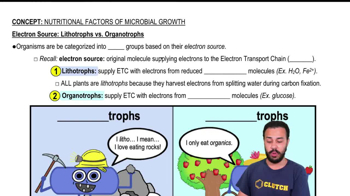 03:21
03:21What do some photosynthetic bacteria use as a source of electrons instead of water?
a. Oxygen (O2)
b. Hydrogen sulfide (H2S)
c. Organic compounds (e.g., CH3COO−)
d. Nitrate (NO3-)
Unlike plant cell walls that contain cellulose, bacterial cell walls are composed of ___________.
Evaluate these statements about Koch's postulates, which are used to establish a causative link between a specific microbe and a specific disease. Select True or False for each statement.
T/FThe microbe must be present in individuals suffering from the disease and absent from healthy individuals.
T/FThe microbe must be isolated and grown in pure culture.
T/FIf organisms from the pure culture are injected into a healthy experimental animal, the disease symptoms should appear.
T/FThe microbe does not have to be isolated from the experimental animal as long as the disease is present.
What has metagenomic analysis allowed researchers to do for the first time? a. sample organisms from an environment and grow them under defined conditions in the lab b. isolate organisms from an environment and sequence their entire genome c. study organisms that cannot be cultured (grown in the lab) d. identify important morphological differences among species