Pearson+ LogoPearson+ Logo
Ch. 26 - Bacteria and Archaea
Freeman - Biological Science 7th Edition
Freeman7th EditionBiological ScienceISBN: 9783584863285Not the one you use?Change textbook
Chapter 26, Problem 4

Evaluate these statements about Koch's postulates, which are used to establish a causative link between a specific microbe and a specific disease. Select True or False for each statement.
T/FThe microbe must be present in individuals suffering from the disease and absent from healthy individuals.
T/FThe microbe must be isolated and grown in pure culture.
T/FIf organisms from the pure culture are injected into a healthy experimental animal, the disease symptoms should appear.
T/FThe microbe does not have to be isolated from the experimental animal as long as the disease is present.

Verified step by step guidance
1
Understand the purpose of Koch's postulates: They are a set of criteria designed to establish a causative relationship between a microbe and a disease. Each postulate must be satisfied to confirm the link.
Analyze the first statement: 'The microbe must be present in individuals suffering from the disease and absent from healthy individuals.' This aligns with the first postulate, which states that the suspected pathogen should be found in all cases of the disease and not in healthy individuals. Determine if this is true or false based on this principle.
Evaluate the second statement: 'The microbe must be isolated and grown in pure culture.' This corresponds to the second postulate, which requires the pathogen to be isolated from the diseased host and grown in pure culture. Assess whether this is true or false.
Examine the third statement: 'If organisms from the pure culture are injected into a healthy experimental animal, the disease symptoms should appear.' This reflects the third postulate, which states that the cultured microbe should cause disease when introduced into a healthy host. Decide if this is true or false.
Review the fourth statement: 'The microbe does not have to be isolated from the experimental animal as long as the disease is present.' This contradicts the fourth postulate, which requires the microbe to be re-isolated from the experimentally infected host and shown to be the same as the original microbe. Determine if this is true or false.

Verified video answer for a similar problem:

This video solution was recommended by our tutors as helpful for the problem above.
Video duration:
27s
Was this helpful?

Key Concepts

Here are the essential concepts you must grasp in order to answer the question correctly.

Koch's Postulates

Koch's postulates are a set of criteria established by Robert Koch to determine the causative relationship between a microbe and a disease. They include the requirement that the microbe must be found in abundance in diseased organisms but not in healthy ones, must be isolated and grown in pure culture, must cause disease when introduced to a healthy host, and must be re-isolated from the experimentally infected host.
Recommended video:
04:12
Natural Selection: Observations and Inferences

Isolation and Culture

Isolation and culture refer to the process of separating a specific microbe from a mixed population and growing it in a controlled environment. This step is crucial for studying the microbe's characteristics and confirming its role in disease causation, as it allows researchers to observe the microbe's behavior and pathogenicity without interference from other organisms.
Recommended video:
02:47
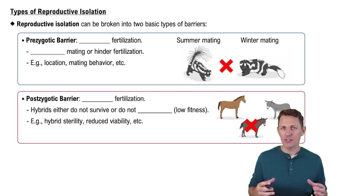
Types of Reproductive Isolation

Experimental Infection

Experimental infection involves introducing a pathogen into a healthy host to observe the development of disease symptoms. This step is essential for establishing a direct link between the microbe and the disease, as it demonstrates that the microbe can cause the same symptoms in a healthy organism, thereby supporting its role as a causative agent.
Recommended video:
Guided course
02:50
Experimental Design Example 1