Pearson+ LogoPearson+ Logo
Ch. 27 - Diversification of Eukaryotes
Freeman - Biological Science 7th Edition
Freeman7th EditionBiological ScienceISBN: 9783584863285Not the one you use?Change textbook
Chapter 27, Problem 4

How can dinoflagellates be harmful to humans? a. They are transmitted by mosquitoes and cause malaria. b. They produce toxins that can be absorbed by clams and other shellfish which, when eaten by people, can lead to paralytic shellfish poisoning. c. They cause amoebic dysentery which leads to severe diarrhea and dehydration. d. They are transmitted by tsetse flies and cause 'sleeping sickness.'

Verified step by step guidance
1
Identify the organism in question: Dinoflagellates are a type of marine plankton, not a virus or bacteria, and are not transmitted by insects.
Understand the nature of harm: Dinoflagellates can produce toxins that are harmful to other marine life and humans.
Relate to human impact: These toxins can accumulate in shellfish that filter large amounts of water containing toxic dinoflagellates.
Recognize symptoms in humans: When humans consume these contaminated shellfish, they can suffer from paralytic shellfish poisoning, which affects the nervous system.
Choose the correct answer: Based on the information, the correct answer is b. They produce toxins that can be absorbed by clams and other shellfish which, when eaten by people, can lead to paralytic shellfish poisoning.

Verified video answer for a similar problem:

This video solution was recommended by our tutors as helpful for the problem above.
Video duration:
2m
Was this helpful?

Key Concepts

Here are the essential concepts you must grasp in order to answer the question correctly.

Dinoflagellates

Dinoflagellates are a group of single-celled organisms found in marine and freshwater environments. They are known for their unique characteristics, including the presence of two flagella that allow them to move. Some species are photosynthetic, while others are heterotrophic. Importantly, certain dinoflagellates can produce harmful toxins that affect marine life and humans.
Recommended video:
Guided course
10:24
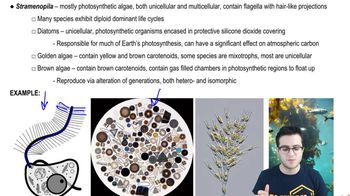
Stramenopila and Alveolata

Toxins and Shellfish Poisoning

Certain dinoflagellates produce potent toxins, such as saxitoxin, which can accumulate in shellfish like clams and mussels. When humans consume these contaminated shellfish, they can experience paralytic shellfish poisoning (PSP), characterized by symptoms such as numbness, dizziness, and in severe cases, respiratory failure. This phenomenon highlights the ecological impact of dinoflagellates on food webs and human health.
Recommended video:
Guided course
03:40
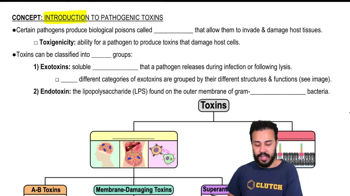
Introduction to Pathogenic Toxins

Harmful Algal Blooms (HABs)

Harmful algal blooms (HABs) occur when certain algae, including toxic dinoflagellates, proliferate excessively in water bodies, often due to nutrient pollution. These blooms can lead to significant ecological and health issues, including fish kills and the contamination of seafood. Understanding HABs is crucial for managing water quality and protecting public health from the risks associated with consuming affected marine organisms.
Recommended video:
Guided course
04:34
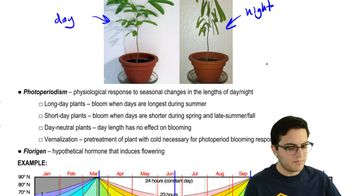
Photoderiodism
Related Practice
Textbook Question

Why are protists considered paraphyletic?

a. They include many extinct forms, including lineages that no longer have any living representatives.

b. They include some but not all descendants of their most recent common ancestor.

c. They represent all of the descendants of a single common ancestor.

d. Not all protists have all of the synapomorphies that define the Eukarya, such as a nucleus.

1340
views
Textbook Question

The most important primary producers in marine ecosystems are ___________.   

1134
views
Textbook Question

Evaluate the following statements regarding motility in protists. Select True or False for each statement.

T/F Amoeboid motion is common in species with cell walls.

T/F Some protists use flagella to swim.

T/F Some protists use cilia to swim, which are shorter and more numerous than flagella.

T/F Amoeboid motion requires ATP and interactions between the proteins actin and myosin.

758
views
Textbook Question
How can dinoflagellates be harmful to humans?a. They are transmitted by mosquitoes and cause malaria.b. They produce toxins that can be absorbed by clams and other shellfish which, when eaten by people, can lead to paralytic shellfish poisoning.c. They cause amoebic dysentery which leads to severe diarrhea and dehydration.d. They are transmitted by tsetse flies and cause 'sleeping sickness.'
2040
views
Textbook Question

Explain the logic behind the claim that the nuclear envelope is a synapomorphy that defines eukaryotes as a monophyletic group.

657
views
Textbook Question

Consider the endosymbiosis theory for the origin of the mitochondrion. How did each endosymbiotic partner benefit from the relationship?

1624
views
1
rank