Pearson+ LogoPearson+ Logo
Ch. 27 - Diversification of Eukaryotes
Freeman - Biological Science 7th Edition
Freeman7th EditionBiological ScienceISBN: 9783584863285Not the one you use?Change textbook
Chapter 27, Problem 2

The most important primary producers in marine ecosystems are ___________.   

Verified step by step guidance
1
Understand the concept of primary producers: Primary producers are organisms that produce organic compounds from carbon dioxide through photosynthesis or chemosynthesis, forming the base of the food web.
Identify the primary producers in marine ecosystems: In marine environments, primary producers are typically photosynthetic organisms that convert sunlight into energy.
Recognize the types of organisms that serve as primary producers in marine ecosystems: The most important primary producers in marine ecosystems are phytoplankton, which include various species of algae and cyanobacteria.
Explore the role of phytoplankton: Phytoplankton are microscopic organisms that float in the water column and perform photosynthesis, producing oxygen and organic materials that support marine life.
Consider the ecological significance: Phytoplankton are crucial for marine ecosystems as they form the foundation of the food web, supporting a wide range of marine organisms from zooplankton to large fish and marine mammals.

Verified video answer for a similar problem:

This video solution was recommended by our tutors as helpful for the problem above.
Video duration:
2m
Was this helpful?

Key Concepts

Here are the essential concepts you must grasp in order to answer the question correctly.

Primary Producers

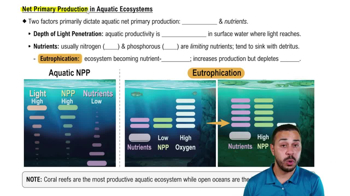
Primary producers are organisms that produce organic compounds from carbon dioxide through photosynthesis or chemosynthesis, forming the base of the food web. In marine ecosystems, they convert solar or chemical energy into biomass, supporting a wide range of marine life. Understanding their role is crucial for grasping energy flow and nutrient cycling in these environments.
Recommended video:
Guided course
04:36
Primary Production in Aquatic Ecosystems

Phytoplankton

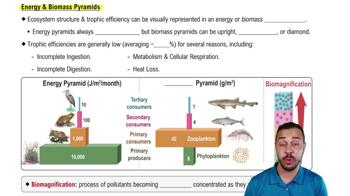
Phytoplankton are microscopic marine algae that serve as the most significant primary producers in ocean ecosystems. They perform photosynthesis, using sunlight to convert carbon dioxide and water into glucose and oxygen, thus providing energy and oxygen to marine food webs. Their abundance and productivity are vital for sustaining marine biodiversity and global carbon cycles.
Recommended video:
Guided course
05:41
Energy & Biomass Pyramids

Marine Ecosystems

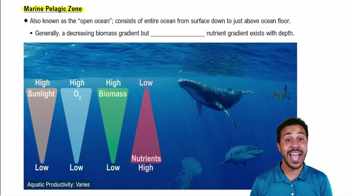
Marine ecosystems encompass the diverse environments found in oceans and seas, characterized by saltwater habitats. These ecosystems include coral reefs, open ocean, and deep-sea environments, each hosting unique communities of organisms. Understanding marine ecosystems involves studying the interactions between organisms and their physical environment, which is essential for conservation and management efforts.
Recommended video:
Guided course
02:14
Marine Pelagic Zone
Related Practice
Textbook Question

Why are protists considered paraphyletic?

a. They include many extinct forms, including lineages that no longer have any living representatives.

b. They include some but not all descendants of their most recent common ancestor.

c. They represent all of the descendants of a single common ancestor.

d. Not all protists have all of the synapomorphies that define the Eukarya, such as a nucleus.

1340
views
Textbook Question

Evaluate the following statements regarding motility in protists. Select True or False for each statement.

T/F Amoeboid motion is common in species with cell walls.

T/F Some protists use flagella to swim.

T/F Some protists use cilia to swim, which are shorter and more numerous than flagella.

T/F Amoeboid motion requires ATP and interactions between the proteins actin and myosin.

758
views
Textbook Question

How can dinoflagellates be harmful to humans? a. They are transmitted by mosquitoes and cause malaria. b. They produce toxins that can be absorbed by clams and other shellfish which, when eaten by people, can lead to paralytic shellfish poisoning. c. They cause amoebic dysentery which leads to severe diarrhea and dehydration. d. They are transmitted by tsetse flies and cause 'sleeping sickness.'

551
views
Textbook Question
How can dinoflagellates be harmful to humans?a. They are transmitted by mosquitoes and cause malaria.b. They produce toxins that can be absorbed by clams and other shellfish which, when eaten by people, can lead to paralytic shellfish poisoning.c. They cause amoebic dysentery which leads to severe diarrhea and dehydration.d. They are transmitted by tsetse flies and cause 'sleeping sickness.'
2040
views