Pearson+ LogoPearson+ Logo
Ch. 9 - Cellular Respiration and Fermentation
Freeman - Biological Science 7th Edition
Freeman7th EditionBiological ScienceISBN: 9783584863285Not the one you use?Change textbook
Chapter 9, Problem 3

After glucose is fully oxidized by glycolysis, pyruvate processing, and the citric acid cycle, where is most of its energy stored?

Verified step by step guidance
1
Identify the main stages of glucose oxidation: Glycolysis, Pyruvate Processing, and the Citric Acid Cycle.
Understand that during these stages, glucose is broken down and its energy is transferred to other molecules.
Recognize that the energy from glucose is primarily stored in the form of high-energy electron carriers (NADH and FADH2) and a small amount in ATP.
Note that NADH and FADH2 carry electrons to the electron transport chain, where most of the ATP is produced during oxidative phosphorylation.
Conclude that after the complete oxidation of glucose, most of its energy is stored in the high-energy electron carriers, NADH and FADH2, which are utilized in the electron transport chain to produce ATP.

Verified video answer for a similar problem:

This video solution was recommended by our tutors as helpful for the problem above.
Video duration:
1m
Was this helpful?

Key Concepts

Here are the essential concepts you must grasp in order to answer the question correctly.

Glycolysis

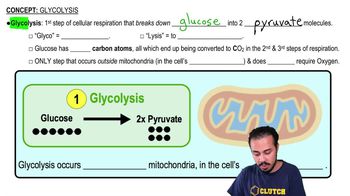
Glycolysis is the first step in the breakdown of glucose, occurring in the cytoplasm of cells. It converts one molecule of glucose into two molecules of pyruvate, producing a net gain of two ATP and two NADH molecules. This process is anaerobic and sets the stage for further energy extraction in aerobic respiration.
Recommended video:

Citric Acid Cycle

The Citric Acid Cycle, also known as the Krebs cycle, takes place in the mitochondria and is a key component of cellular respiration. It processes acetyl-CoA, derived from pyruvate, to produce energy-rich electron carriers, NADH and FADH2, along with ATP. This cycle is crucial for the complete oxidation of glucose and the release of stored energy.
Recommended video:

Electron Transport Chain

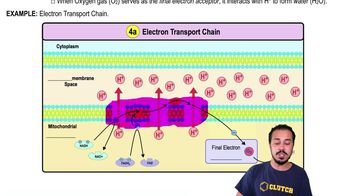
The Electron Transport Chain (ETC) is the final stage of aerobic respiration, located in the inner mitochondrial membrane. It utilizes the NADH and FADH2 produced in earlier stages to create a proton gradient, driving ATP synthesis through oxidative phosphorylation. Most of the energy from glucose oxidation is stored in the form of ATP generated during this process.
Recommended video:
Guided course
07:41
Electron Transport Chain
Related Practice
Textbook Question

Where does the citric acid cycle occur in eukaryotes? a. in the cytosol of cells b. in the intermembrane space of mitochondria c. in the inner membrane of mitochondria d. in the matrix of mitochondria

1696
views
Textbook Question
Where does the citric acid cycle occur in eukaryotes?a. in the cytosol of cellsb. in the intermembrane space of mitochondriac. in the inner membrane of mitochondriad. in the matrix of mitochondria
1533
views
Textbook Question

What does the chemiosmotic hypothesis claim?

a. ATP is generated using phosphates taken from intermediates in the electron transport chain.

b. ATP is generated using a phosphate gradient produced by glycolysis and the citric acid cycle.

c. ATP is generated using a proton-motive force that is produced by the electron transport chain.

d. Water is generated using electrons taken from NADH and FADH2 and transported through the electron transport chain.

1700
views
Textbook Question
After glucose is fully oxidized by glycolysis, pyruvate processing, and the citric acid cycle, where is most of its energy stored?
1788
views
Textbook Question

Which of the following correctly describe the fermentation pathway? Select True or False for each statement.

T/FIt includes a reaction that oxidizes NADH to NAD+.

T/FIt synthesizes ATP by substrate-level phosphorylation.

T/FIt includes a reaction that reduces NAD+ to NADH.

T/FIt synthesizes electron acceptors, so that cellular respiration can continue.

2195
views
Textbook Question

Compare and contrast substrate-level phosphorylation and oxidative phosphorylation.

1689
views