
Textbook Question
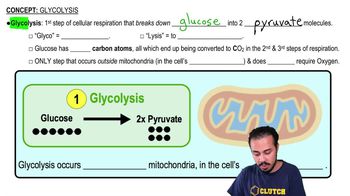
Where does the citric acid cycle occur in eukaryotes?a. in the cytosol of cellsb. in the intermembrane space of mitochondriac. in the inner membrane of mitochondriad. in the matrix of mitochondria
1533
views



 Verified step by step guidance
 05:04
05:04
 02:45
02:45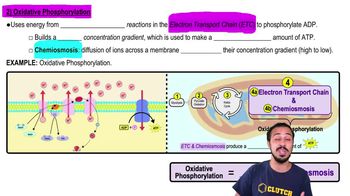 06:27
06:27What does the chemiosmotic hypothesis claim?
a. ATP is generated using phosphates taken from intermediates in the electron transport chain.
b. ATP is generated using a phosphate gradient produced by glycolysis and the citric acid cycle.
c. ATP is generated using a proton-motive force that is produced by the electron transport chain.
d. Water is generated using electrons taken from NADH and FADH2 and transported through the electron transport chain.
After glucose is fully oxidized by glycolysis, pyruvate processing, and the citric acid cycle, where is most of its energy stored?
Which of the following correctly describe the fermentation pathway? Select True or False for each statement.
T/FIt includes a reaction that oxidizes NADH to NAD+.
T/FIt synthesizes ATP by substrate-level phosphorylation.
T/FIt includes a reaction that reduces NAD+ to NADH.
T/FIt synthesizes electron acceptors, so that cellular respiration can continue.
Compare and contrast substrate-level phosphorylation and oxidative phosphorylation.