Pearson+ LogoPearson+ Logo
Ch. 9 - Cellular Respiration and Fermentation
Freeman - Biological Science 7th Edition
Freeman7th EditionBiological ScienceISBN: 9783584863285Not the one you use?Change textbook
Chapter 9, Problem 5

Compare and contrast substrate-level phosphorylation and oxidative phosphorylation.

Verified step by step guidance
1
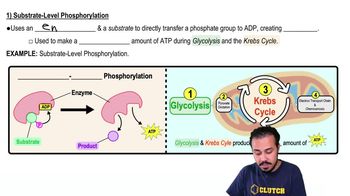
Understand the basic definitions: Substrate-level phosphorylation involves the direct transfer of a phosphate group from a substrate molecule to ADP, forming ATP. This process occurs in the cytoplasm during glycolysis and in the mitochondria during the Krebs cycle. Oxidative phosphorylation, on the other hand, involves the production of ATP using the energy derived from the electron transport chain and occurs in the inner mitochondrial membrane.
Identify the location and conditions: Substrate-level phosphorylation occurs in both the cytoplasm and mitochondria and does not require oxygen, making it an anaerobic process. Oxidative phosphorylation takes place in the mitochondria and requires oxygen, making it an aerobic process.
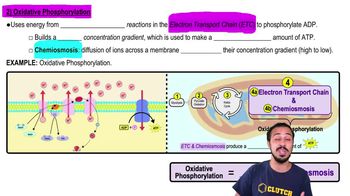
Examine the role of enzymes and intermediates: In substrate-level phosphorylation, specific enzymes directly facilitate the transfer of phosphate to ADP. In oxidative phosphorylation, the process is driven by a series of protein complexes and mobile electron carriers in the electron transport chain, ultimately leading to the generation of a proton gradient that drives ATP synthesis through ATP synthase.
Consider the efficiency and yield: Oxidative phosphorylation is generally more efficient, producing up to about 34 ATP molecules per glucose molecule, compared to a smaller yield from substrate-level phosphorylation, which contributes directly to the formation of only 4 ATP molecules per glucose molecule.
Discuss the biological significance: Both processes are crucial for cellular energy production, but oxidative phosphorylation provides the majority of the ATP used by aerobic cells to support energy-intensive processes, while substrate-level phosphorylation can supply energy quickly even in the absence of oxygen.

Verified video answer for a similar problem:

This video solution was recommended by our tutors as helpful for the problem above.
Video duration:
4m
Was this helpful?

Key Concepts

Here are the essential concepts you must grasp in order to answer the question correctly.

Substrate-Level Phosphorylation

Substrate-level phosphorylation is a metabolic process that directly generates ATP by transferring a phosphate group from a substrate molecule to ADP. This occurs in specific enzymatic reactions, primarily during glycolysis and the Krebs cycle. Unlike oxidative phosphorylation, it does not involve the electron transport chain and is less efficient in terms of ATP yield.
Recommended video:
Guided course
03:00
Substrate-Level Phosphorylation

Oxidative Phosphorylation

Oxidative phosphorylation is a process that occurs in the mitochondria, where ATP is produced through the electron transport chain and chemiosmosis. Electrons from NADH and FADH2 are transferred through a series of proteins, creating a proton gradient that drives ATP synthesis via ATP synthase. This method is more efficient than substrate-level phosphorylation, yielding significantly more ATP per glucose molecule.
Recommended video:
Guided course
06:27
Oxidative Phosphorylation

ATP Yield Comparison

The comparison of ATP yield between substrate-level and oxidative phosphorylation highlights their efficiency differences. Substrate-level phosphorylation typically produces 2 ATP molecules per glucose during glycolysis and the Krebs cycle, while oxidative phosphorylation can generate approximately 28-34 ATP molecules per glucose. This stark contrast underscores the importance of oxidative phosphorylation in cellular respiration and energy production.
Recommended video: