 Back
BackBusiness Calculus Study Guide: Limits, Continuity, Derivatives, and Cost Analysis
Study Guide - Smart Notes
 Tailored notes based on your materials, expanded with key definitions, examples, and context.
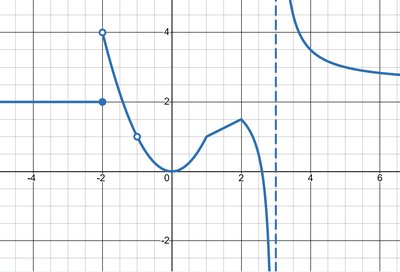
Q1. Evaluate the following limits for the function whose graph is shown:
Background
Topic: Limits from Graphs
This question tests your ability to interpret a graph and evaluate limits from both the left and right at specific points. Understanding how the function behaves near these points is crucial for calculus and business applications.
Key Terms and Formulas:
Limit: The value a function approaches as the input approaches a certain point.
Left-hand limit (): The value as approaches from the left.
Right-hand limit (): The value as approaches from the right.
Overall limit (): Exists only if left and right limits are equal.
Step-by-Step Guidance
Examine the graph at each specified -value (e.g., ) and observe how behaves as $x$ approaches from the left and right.
For each limit, identify whether there is a jump, hole, or asymptote at the point. This will affect whether the limit exists and what value it approaches.
For left-hand and right-hand limits, trace the graph from the left and right sides of the point, noting the -value the function approaches.
If the left and right limits are equal, the overall limit exists and equals that value. If not, the overall limit does not exist at that point.
Use the graph to check for open or closed circles, which indicate whether the function is defined at that point or if there is a discontinuity.
Repeat this process for each limit listed in the question.
Try solving on your own before revealing the answer!
Final Answer:
Each limit can be evaluated by carefully observing the graph at the specified points. For example, at , the left-hand and right-hand limits may differ if there is a jump. At , check for holes or jumps. At , look for vertical asymptotes.
Refer to the graph and use the step-by-step process above to find the exact values for each limit.
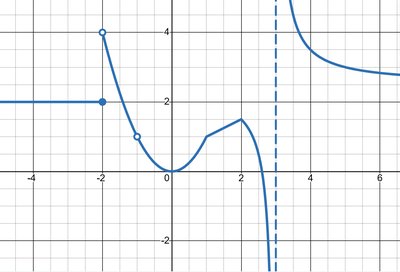
Q2. Discuss the continuity of , denoting the location and type of each discontinuity. BONUS: Give the domain in interval notation.
Background
Topic: Continuity and Discontinuities
This question tests your understanding of continuity, types of discontinuities (jump, removable, infinite), and how to determine the domain of a function from its graph.
Key Terms and Formulas:
Continuous at : is continuous if .
Discontinuity: A point where the function is not continuous.
Types: Jump (left/right limits differ), Removable (hole), Infinite (vertical asymptote).
Domain: All -values for which is defined.
Step-by-Step Guidance
Scan the graph for points where the function is not continuous (e.g., jumps, holes, vertical asymptotes).
For each discontinuity, note the -value and determine the type (jump, removable, infinite).
Check for open circles (removable), sudden jumps (jump), and dashed lines (infinite).
List all -values where discontinuities occur and classify each.
For the domain, identify all intervals where the function is defined, excluding points of infinite discontinuity.
Try solving on your own before revealing the answer!
Final Answer:
Discontinuities occur at points where the graph has jumps, holes, or vertical asymptotes. The domain excludes points of infinite discontinuity. Use interval notation to express the domain.
Q3. Use the Four-Step Procedure to compute the derivative of .
Background
Topic: Derivative Definition (Four-Step Procedure)
This question tests your ability to use the formal definition of the derivative to find for a quadratic function.
Key Terms and Formulas:
Derivative: The rate of change of a function.
Four-Step Procedure: Uses the limit definition .
Step-by-Step Guidance
Write the function: .
Compute : Substitute into the function.
Find and simplify the expression.
Divide by to set up the difference quotient.
Take the limit as to find the derivative.
Try solving on your own before revealing the answer!
Final Answer:
The derivative is found by applying the Four-Step Procedure. After simplifying, you will get a linear function representing .
Q4. Compute derivatives for the following functions (do NOT use the Four-Step Procedure):
Background
Topic: Basic Differentiation Rules
This question tests your ability to apply power, sum, and constant rules to find derivatives quickly.
Key Terms and Formulas:
Power Rule:
Sum Rule:
Constant Rule:
Step-by-Step Guidance
For each function, identify the terms and apply the appropriate rule to each term.
For , apply the power rule to each term.
For , rewrite radicals as exponents and apply the power rule.
For , apply the power rule to each term.
Try solving on your own before revealing the answer!
Final Answer:
Each derivative is computed by applying the power rule to each term. Simplify the results for each function.
Q5. The total cost for producing bicycles is . Calculate the total cost and marginal cost at . Compute the average cost and marginal average cost at $x = 100$.
Background
Topic: Cost Functions and Marginal Analysis
This question tests your ability to apply calculus to business problems, specifically cost analysis and marginal cost concepts.
Key Terms and Formulas:
Total Cost:
Marginal Cost: , the derivative of the cost function
Average Cost:
Marginal Average Cost: Derivative of average cost with respect to
Step-by-Step Guidance
Plug into to find the total cost.
Find by differentiating with respect to .
Plug into to find the marginal cost.
Compute the average cost by dividing by $100$.
Find the derivative of the average cost function and evaluate at for marginal average cost.
Try solving on your own before revealing the answer!
Final Answer:
Total cost, marginal cost, average cost, and marginal average cost can be found by plugging into the respective formulas. Interpret the results in the context of bicycle production.
Q6. Compute derivatives of the following functions:
Background
Topic: Advanced Differentiation Techniques
This question tests your ability to use product, quotient, and chain rules for differentiation.
Key Terms and Formulas:
Product Rule:
Quotient Rule:
Chain Rule:
Derivative of :
Derivative of :
Step-by-Step Guidance
For , use the product rule.
For , use the quotient rule.
For , use the chain rule and product rule.
Write out each derivative step-by-step, showing intermediate steps.
Try solving on your own before revealing the answer!
Final Answer:
Each derivative is computed using the appropriate rule. Simplify the results for each function.
