 Back
BackContinuity and Sign Charts in Business Calculus
Study Guide - Smart Notes
 Tailored notes based on your materials, expanded with key definitions, examples, and context.
Continuity of Functions
Informal Definition of Continuity
Continuity is a fundamental concept in calculus, describing how a function behaves over an interval. Informally, a function is continuous over an interval if its graph can be drawn without lifting the pen from the paper.
Continuous Function: The graph is unbroken over the interval.
Discontinuous Function: The graph has breaks, jumps, or holes at certain points.
Example: The function f in Figure A is continuous for all x.
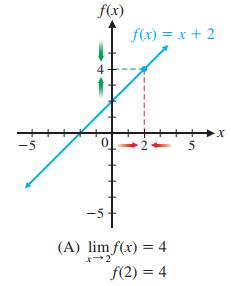
Discontinuity
A function is discontinuous at a point x = c if its graph is broken or disconnected at that point. Discontinuities can occur due to jumps, holes, or undefined values.
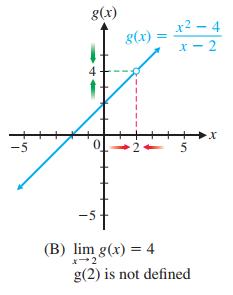
Example: The function g in Figure B is continuous except at x = 2.
Example: The function h in Figure C is discontinuous at x = 0 but continuous elsewhere.
Formal Definition of Continuity at a Point
A function f is continuous at a point x = c if all three of the following conditions are met:
1. exists
2. exists
3.
If any of these conditions fail, the function is discontinuous at x = c.
Continuity on Intervals
A function is continuous on an open interval if it is continuous at every point in the interval. For a closed interval , the function must be continuous on and also continuous from the right at and from the left at .
Analyzing Continuity from Graphs and Equations
Discontinuity from Graphs
To determine continuity from a graph, check the three conditions at each point of interest. If the limit from the left and right are not equal, or the function value does not match the limit, discontinuity occurs.
Example: At , , , so the limit does not exist. Discontinuous at .
Example: At , , but does not exist. Discontinuous at .
Example: At , both the limit and function value do not exist. Discontinuous at .
Example: At , , but . Discontinuous at .
Continuity from Equations
Polynomial Functions: Continuous everywhere. Example: is continuous at since .
Rational Functions: Continuous except where the denominator is zero. Example: is not continuous at .
Absolute Value and Piecewise Functions: May be discontinuous at points where the definition changes or is not defined.
One-Sided Continuity
Continuous on the Right at :
Continuous on the Left at :
Continuous on Closed Interval : Continuous on , right at , and left at .
General Properties of Continuity
Algebraic Properties
If two functions are continuous on the same interval, their sum, difference, product, and quotient (except where the denominator is zero) are also continuous on that interval.
Theorem: Continuity of Specific Functions
Constant Function: is continuous for all .
Power Function: is continuous for all (for positive integer).
Polynomial Function: Continuous for all .
Rational Function: Continuous except where denominator is zero.
Odd Root Function: (odd ) is continuous wherever is continuous.
Even Root Function: (even ) is continuous wherever is continuous and nonnegative.
Examples of Continuity
Polynomial: is continuous for all .
Rational: is continuous except at and .
Odd Root: is continuous for all .
Even Root: is continuous for .
Sign Charts and Solving Inequalities
Sign Charts
A sign chart is a tool for analyzing the sign (positive or negative) of a function over intervals. It is especially useful for solving inequalities and understanding where a function changes sign.
Partition Number: A real number is a partition number for if is discontinuous at or .
Partition numbers divide the real number line into intervals where the function does not change sign.
Theorem: Sign Properties on an Interval
If is continuous on and for all in , then either for all in or for all in .
Procedure: Constructing Sign Charts
Find all partition numbers: where is discontinuous or .
Plot these numbers on a real number line, dividing it into intervals.
Select a test number in each interval and evaluate to determine its sign.
Construct the sign chart, showing the sign of on each interval.
Example: Solving a Rational Inequality
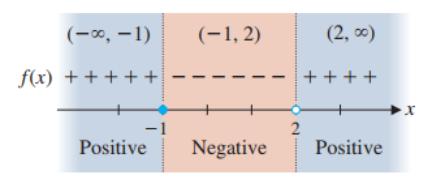
Solve .
Partition numbers: (numerator zero), (denominator zero).
Intervals: , , .
Test points: , , .
Signs: (positive), (negative), (positive).
Solution: for or .
Example: Positive Profit in Business Application
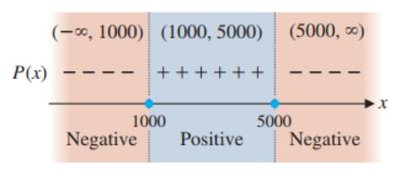
A bakery estimates its annual profit from selling loaves of bread as . To find when profit is positive:
Factor:
Partition numbers: ,
Intervals: , ,
Test points: , ,
Signs: (negative), (positive), (negative)
Conclusion: Profit is positive for
Summary Table: Continuity Properties
Function Type | Continuity |
|---|---|
Constant | All x |
Polynomial | All x |
Rational | All x except denominator zero |
Odd Root | Where function is continuous |
Even Root | Where function is continuous and nonnegative |
Additional info: These notes expand on the original slides by providing formal definitions, step-by-step procedures, and business applications relevant to business calculus students.
