 Back
BackDerivatives of Exponential and Logarithmic Functions
Study Guide - Smart Notes
 Tailored notes based on your materials, expanded with key definitions, examples, and context.
Exponential and Logarithmic Functions
Introduction to Exponential and Logarithmic Differentiation
Exponential and logarithmic functions are fundamental in calculus, especially in business applications involving growth and decay, interest calculations, and elasticity. Their derivatives are essential for solving optimization and modeling problems.
Differentiation of Logarithmic Functions
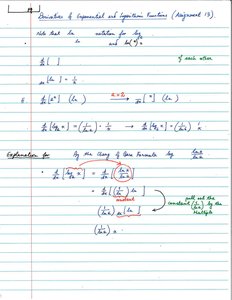
Derivative of the Natural Logarithm Function
The derivative of the natural logarithm function, ln(x), is a foundational result in calculus. It is used extensively in simplifying the differentiation of more complex functions.
Key Formula: The derivative of with respect to is: $
Chain Rule Application: For a composite function : $
Example: If , then: $
Differentiation of Exponential Functions
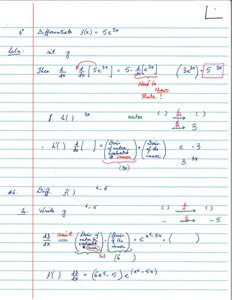
Derivative of the Exponential Function
The exponential function and its generalizations are widely used in business calculus for modeling continuous growth and decay. Their derivatives are straightforward but require careful application of the chain rule for composite exponents.
Key Formula: The derivative of is: $
Chain Rule Application: For : $
Example: If , then: $
Product Rule with Exponential Functions
Differentiating Products Involving Exponentials
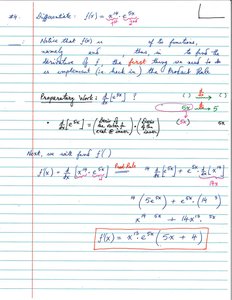
When differentiating a product of a polynomial and an exponential function, the Product Rule is used. This is common in business calculus when modeling revenue, cost, or population functions.
Product Rule: For : $
Example: Differentiate :
Let ,
So, $
Inverse Relationship of Exponential and Logarithmic Functions
Understanding Inverse Functions
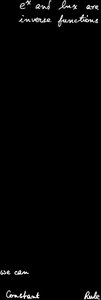
The exponential function and the natural logarithm are inverse functions. This relationship is crucial for solving equations and understanding their derivatives.
Inverse Property: and for .
Application: This property is often used to simplify expressions before differentiation or integration.
Summary Table: Key Derivative Rules
Function | Derivative |
|---|---|
Additional info: These rules are foundational for business calculus, especially in applications involving continuous growth, decay, and elasticity analysis.
