 Back
BackDerivatives of Exponential and Logarithmic Functions- Chapter 3
Study Guide - Smart Notes
 Tailored notes based on your materials, expanded with key definitions, examples, and context.
Additional Derivative Topics
Derivatives of Exponential and Logarithmic Functions
This section explores the calculus of exponential and logarithmic functions, which are fundamental in business applications such as growth models, demand equations, and compound interest. Understanding their derivatives is essential for analyzing rates of change in economic and financial contexts.
The Derivative of the Exponential Function
Definition: The exponential function is unique because its derivative is itself.
Formula:
Key Property: The power rule does not apply to ; instead, use the definition above.
Caution: When using calculators or technology, ensure you use the designated 'e' for the exponential function.
Example: If , then .
Review of Properties of Natural Logarithm ()
Inverse Relationship: The natural logarithm function is the inverse of the exponential function .
Logarithmic Form: For and , is equivalent to .
Domain and Range:
Domain of :
Range of :
Domain of :
Range of :
Graph Symmetry: The graphs of and are symmetric with respect to the line .
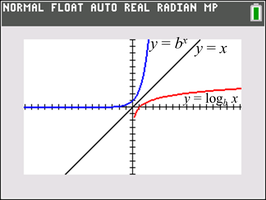
Derivative of the Natural Logarithm ()
Formula:
Derivation: Uses the limit property: If exists and is positive, then .
Example: If , then .
Derivatives of Other Logarithmic and Exponential Functions
General Exponential Function: For (where ),
General Logarithmic Function: For ,
Change of Base: Logarithms and exponentials can be rewritten in terms of natural logarithms and exponentials for easier differentiation.
Change of Base for Logarithms and Exponentials
Logarithm Change of Base:
Exponential Change of Base:
Differentiation: Differentiating both sides allows for finding derivatives with respect to any base.
Summary Table: Derivatives of Exponential and Logarithmic Functions
Function | Derivative |
|---|---|
Applications and Examples
Example 1: Finding Derivatives
Problem: Find for and .
Solution:
(A)
(B)
Example 2: Derivatives with Other Bases
Problem: Find for and .
Solution:
(A)
(B)
Example 3: Exponential Model in Business
Scenario: An online store sells guitar strings. The price demand equation is given, and the rate of change of price with respect to demand is sought when demand is 100 sets.
Solution: When , the price per set is decreasing at a rate of about 2 cents per set.
Interpretation: This means as demand increases, the price drops, which is typical in competitive markets.
Example 4: Continuous Compound Interest
Scenario: An investment of earns interest at an annual rate of 4% compounded continuously.
Formula:
(A) Instantaneous Rate of Change after 2 Years: per year.
(B) Rate of Change when Balance is : per year.
Interpretation: The rate of change is always 4% of the current balance.
Example 5: Logarithm Model for Franchise Growth
Scenario: The number of locations of a sandwich shop franchise is modeled logarithmically.
Formula: , where corresponds to 1980.
(A) Estimate for 2028: , locations.
(B) Rate of Change in 2028: locations per year.
Interpretation: The franchise is growing at a steady rate, as indicated by the derivative.
