 Back
BackFinding Vertical Asymptotes for Rational Functions
Study Guide - Smart Notes
 Tailored notes based on your materials, expanded with key definitions, examples, and context.
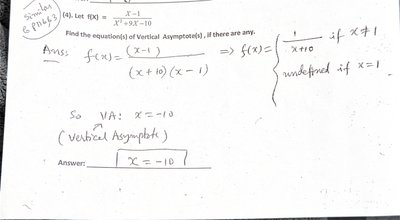
Q1. Find the equation(s) of vertical asymptote(s) for the function , if there are any.
Background
Topic: Rational Functions & Asymptotes
This question tests your understanding of how to find vertical asymptotes for rational functions. Vertical asymptotes occur where the denominator of the function equals zero (and the numerator does not also equal zero at that point).
Key Terms and Formulas
Vertical Asymptote: A line where the function approaches infinity or negative infinity as approaches .
Rational Function: A function of the form where and are polynomials.
To find vertical asymptotes: Set the denominator equal to zero and solve for .
Step-by-Step Guidance
Write the denominator of the function: .
Factor the denominator: .
Set each factor equal to zero to find potential vertical asymptotes: and .
Check if the numerator is also zero at these points. If both numerator and denominator are zero at the same value, it is not a vertical asymptote (it may be a hole).
Try solving on your own before revealing the answer!
Final Answer:
At , the denominator is zero and the numerator is not zero, so there is a vertical asymptote at $x = -10$. At , both numerator and denominator are zero, so this is not a vertical asymptote (it is a removable discontinuity).
