 Back
BackRelated Rates- Chapter 3
Study Guide - Smart Notes
 Tailored notes based on your materials, expanded with key definitions, examples, and context.
Additional Derivative Topics
Related Rates: Introduction and Motivation
Related rates problems involve determining how the rates of change of two or more related quantities are connected, typically with respect to time. These problems are highly relevant in business, economics, and the sciences, as they allow us to analyze how changes in one variable affect another.
Key Point 1: Related rates problems arise when two or more quantities change over time and are mathematically linked.
Key Point 2: Applications include financial aid versus tuition increases, rent versus income, sales versus interest rates, and wages versus company profits.
Example: If tuition rises faster than financial aid, related rates can quantify the gap.
General Approach to Solving Related Rates Problems
Solving related rates problems requires a systematic approach to connect variables and their rates of change.
Step 1: Sketch a figure if helpful.
Step 2: Identify all relevant variables and their rates.
Step 3: Express rates as derivatives with respect to time.
Step 4: Find an equation connecting the variables.
Step 5: Implicitly differentiate the equation using the chain rule.
Step 6: Substitute known values and solve for the unknown rate.
Related Rates and Motion
Example 1: Ladder Sliding Down a Wall
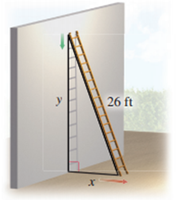
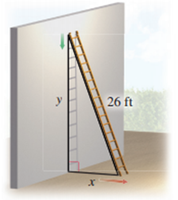
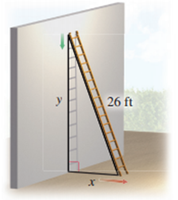
This classic related rates problem involves a ladder sliding down a wall, with both the height of the ladder on the wall and the distance from the wall to the base changing over time.
Key Point 1: Let x be the distance from the wall to the bottom of the ladder, and y be the distance from the floor to the top.
Key Point 2: The relationship is given by the Pythagorean theorem: .
Key Point 3: Both x and y are functions of time, so their rates of change are related.
Example: If the top slides down at 2 ft/sec, find how fast the bottom moves away when x = 10 ft.
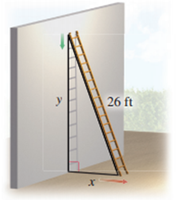
Implicit differentiation gives: Solving for : When x = 10 ft, y = 24 ft (from ). Substitute values to find the rate.
Example 2: Distance Between Two Moving Planes
Two planes move away from an airport in perpendicular directions. The rate at which the distance between them changes is a related rates problem.
Key Point 1: Let W and N be the distances from the airport for the westbound and northbound planes.
Key Point 2: The distance between the planes is .
Key Point 3: Use implicit differentiation: .
Example: After 0.5 hours, find the rate at which the distance between the planes is changing.
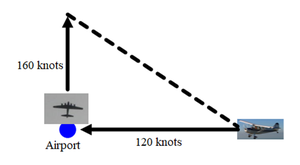
Substitute values: W = 60, N = 80, D = 100, = -120 knots, = 160 knots. Solving gives knots.
Example 3: Point Moving Along a Circle
A point moves along a circle of radius 5. If the x-coordinate changes at a certain rate, find the rate of change of the y-coordinate at a specific point.
Key Point 1: The circle equation is .
Key Point 2: Both x and y are functions of time.
Key Point 3: Implicit differentiation: .
Example: At (−3, 4), with , solve for .
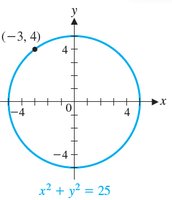
Substitute values: Solving gives units/sec.
Related Rates in Business Applications
Cost, Revenue, and Profit Rates
In business calculus, related rates are used to analyze how changes in production affect cost, revenue, and profit over time.
Key Point 1: Cost, revenue, and profit are functions of production output, which can change over time.
Key Point 2: If production increases at a certain rate, differentiate the cost, revenue, and profit functions with respect to time to find their rates of change.
Example: If production increases by 500 units/week at 2,000 units, find the rate of increase in cost, revenue, and profit.
Cost Rate: If is the cost function and changes at rate , then . Revenue Rate: . Profit Rate: .
Result: For the given example, cost increases at $1,000/week, revenue at $3,000/week, and profit at $2,000/week.
Additional info: These business applications demonstrate how calculus can be used to optimize and predict financial outcomes based on production changes.
