Skip to main content
Statistics for Business
My Course
Learn
Exam Prep
AI Tutor
Study Guides
Flashcards
Explore
Try the app
My Course
Learn
Exam Prep
AI Tutor
Study Guides
Flashcards
Explore
Try the app
Back
Complements definitions
You can tap to flip the card.
Complement
You can tap to flip the card.
👆
Complement
All possible outcomes where a specific event does not occur, forming a complete set with the event itself.
Track progress
Control buttons has been changed to "navigation" mode.
1/15
Related flashcards
Related practice
Recommended videos
Complements quiz
Complements
15 Terms
Complements
4. Probability
10 problems
Topic
Ernest
Addition Rule
4. Probability
10 problems
Topic
Ernest
4. Probability
9 topics
15 problems
Chapter
Ernest
4:23
Complementary Events
575
views
16
rank
Terms in this set (15)
Hide definitions
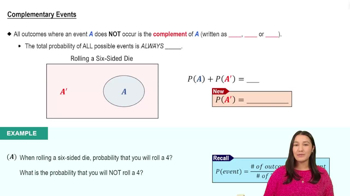
Complement
All possible outcomes where a specific event does not occur, forming a complete set with the event itself.
Probability
A numerical measure between 0 and 1 representing the likelihood of an event occurring among all possible outcomes.
Event
A specific outcome or group of outcomes of a random experiment, such as rolling a four on a die.
Outcome
A single possible result from a random process, like drawing a card or rolling a die.
Complement Rule
A principle stating that the probability of an event plus its complement equals one.
Notation
Symbols or marks used to represent mathematical concepts, such as an apostrophe or bar for complements.
Sample Space
The complete set of all possible outcomes in a random experiment.
Formula
A mathematical expression, such as P(¬A) = 1 - P(A), used to calculate probabilities.
Six-sided Die
A cube with faces numbered one through six, commonly used in probability examples.
Standard Deck
A set of 52 playing cards, including four suits and four cards of each rank.
Denominator
The bottom number in a fraction, representing the total number of possible outcomes.
Numerator
The top number in a fraction, indicating the number of favorable outcomes for an event.
Decimal
A numerical representation of probability, such as 0.92, derived from a fraction.
Random Experiment
A process that produces uncertain results, like rolling dice or drawing cards.
Queen
A specific card rank used as an example in probability calculations with a standard deck.
 BackBack
 4:23
4:23