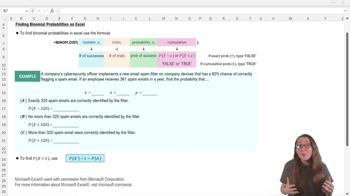
What is the purpose of Excel's BINOM.DIST function?
BINOM.DIST calculates binomial probabilities by inputting the number of successes, trials, and probability of success. It can compute exact or cumulative probabilities depending on the fourth argument.
What are the four arguments required for the BINOM.DIST function in Excel?
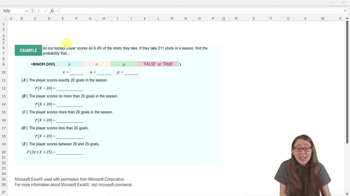
The four arguments are: number of successes (x), number of trials (n), probability of success (p), and whether the probability is cumulative (TRUE or FALSE).
How do you specify an exact probability in BINOM.DIST?
Set the fourth argument to FALSE to calculate the probability that x equals a specific value. This tells Excel to find the exact probability.
How do you specify a cumulative probability in BINOM.DIST?
Set the fourth argument to TRUE to calculate the probability that x is less than or equal to a specific value. This tells Excel to find the cumulative probability.
What does the 'number_s' argument represent in BINOM.DIST?
'number_s' represents the desired number of successes, which is the x value in binomial probability problems.
What does the 'trials' argument represent in BINOM.DIST?
'trials' represents the total number of trials, which is the n value in binomial probability problems.
What does the 'probability_s' argument represent in BINOM.DIST?
'probability_s' is the probability of success in any given trial, represented as a decimal.
How do you convert a percentage probability to a decimal for BINOM.DIST?
Divide the percentage by 100; for example, 92% becomes 0.92 as a decimal.
How do you find the probability that x is greater than a value using BINOM.DIST?
Use the complement rule: calculate 1 minus the probability that x is less than or equal to the value using BINOM.DIST with TRUE.
What is the complement rule in probability?
The complement rule states that the probability of an event is 1 minus the probability of its complement.
How can you check if your probabilities for complementary events are correct?
Add the probabilities for the two complementary events; they should sum to 1.
What is the formula for finding the probability that more than x successes occur?
The formula is 1 − P(X ≤ x), where P(X ≤ x) is found using BINOM.DIST with TRUE.
How do you use Excel to calculate the probability that exactly 320 successes occur out of 361 trials with a 0.92 success rate?
Use =BINOM.DIST(320, 361, 0.92, FALSE) in Excel to find the exact probability.
How do you use Excel to calculate the probability that no more than 320 successes occur out of 361 trials with a 0.92 success rate?
Use =BINOM.DIST(320, 361, 0.92, TRUE) in Excel to find the cumulative probability.
How can you use Excel to find the probability that more than 320 successes occur out of 361 trials with a 0.92 success rate?
Calculate 1 minus the cumulative probability: =1 - BINOM.DIST(320, 361, 0.92, TRUE).
 Back
Back
 08:48
08:48