Skip to main content
Statistics for Business
My Course
Learn
Exam Prep
AI Tutor
Study Guides
Flashcards
Explore
Try the app
My Course
Learn
Exam Prep
AI Tutor
Study Guides
Flashcards
Explore
Try the app
Back
Finding Probabilities, Z Values, and X Values with the Normal Distribution-Excel definitions
You can tap to flip the card.
Standard Normal Distribution
You can tap to flip the card.
👆
Standard Normal Distribution
A symmetric, bell-shaped curve with mean zero and standard deviation one, used for standardized z-scores.
Track progress
Control buttons has been changed to "navigation" mode.
1/15
Related flashcards
Related practice
Recommended videos
Finding Probabilities, Z Values, and X Values with the Normal Distribution-Excel quiz
Finding Probabilities, Z Values, and X Values with the Normal Distribution-Excel
15 Terms
Non-Standard Normal Distribution
6. Normal Distribution & Continuous Random Variables
10 problems
Topic
Ernest
6. Normal Distribution & Continuous Random Variables
4 topics
15 problems
Chapter
Ernest
Guided course
08:09
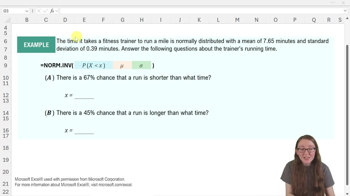
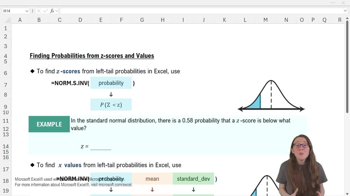
Finding Z-Scores and X Values from Probabilities-Excel
140
views
5
rank
Guided course
09:58
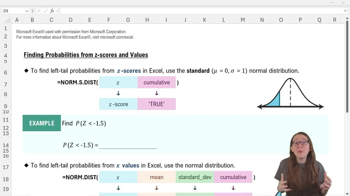
Finding Probabilities from Z-Scores and X Values-Excel
254
views
1
rank
Guided course
03:05
Finding Z-Scores and X Values from Probabilities-Excel Example 2
83
views
1
rank
Terms in this set (15)
Hide definitions
Standard Normal Distribution
A symmetric, bell-shaped curve with mean zero and standard deviation one, used for standardized z-scores.
Z-Score
A standardized value indicating how many standard deviations a data point is from the mean.
Cumulative Probability
The likelihood that a variable is less than or equal to a specific value, represented by the area under the curve to the left.
Left Tail Probability
The probability that a value falls below a specified point in a distribution.
Right Tail Probability
The probability that a value exceeds a specified point in a distribution.
Complement Rule
A method for finding the probability of an event by subtracting the probability of its complement from one.
Population Mean
The average value of all observations in a population, often denoted as mu.
Population Standard Deviation
A measure of the spread of values in a population, denoted as sigma.
Normal Distribution
A continuous, symmetric probability distribution defined by its mean and standard deviation.
X Value
A specific data point or observed value within a normal distribution.
NORM.S.DIST
An Excel function that returns the cumulative probability for a given z-score in the standard normal distribution.
NORM.DIST
An Excel function that returns the cumulative probability for a given x value, mean, and standard deviation.
NORM.S.INV
An Excel function that returns the z-score corresponding to a given cumulative probability in the standard normal distribution.
NORM.INV
An Excel function that returns the x value corresponding to a given cumulative probability, mean, and standard deviation.
68–95–99.7 Rule
A guideline stating that about 68%, 95%, and 99.7% of data in a normal distribution fall within one, two, and three standard deviations from the mean.
 BackBack
 08:09
08:09