Skip to main content
Statistics for Business
My Course
Learn
Exam Prep
AI Tutor
Study Guides
Flashcards
Explore
Try the app
My Course
Learn
Exam Prep
AI Tutor
Study Guides
Flashcards
Explore
Try the app
Back
Histograms definitions
You can tap to flip the card.
Histogram
You can tap to flip the card.
👆
Histogram
Graphical display using adjacent vertical bars to represent frequencies of quantitative data across intervals.
Track progress
Control buttons has been changed to "navigation" mode.
1/15
Related flashcards
Related practice
Recommended videos
Histograms quiz
Histograms
15 Terms
Histograms
2. Describing Data with Tables and Graphs
10 problems
Topic
Jonathan
Histograms w/ Graphing Calculator
2. Describing Data with Tables and Graphs
10 problems
Topic
2. Describing Data with Tables and Graphs
10 topics
15 problems
Chapter
David-Paige
Guided course
05:54
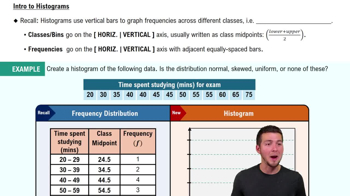
Intro to Histograms
465
views
11
rank
Terms in this set (15)
Hide definitions
Histogram
Graphical display using adjacent vertical bars to represent frequencies of quantitative data across intervals.
Frequency Distribution
Table organizing data values into classes or bins, showing how often each class occurs.
Quantitative Data
Numerical information that can be measured or counted, suitable for mathematical analysis.
Class Midpoint
Value found by averaging the upper and lower boundaries of a class interval, used for labeling axes.
Class Interval
Range of values grouped together in a frequency distribution, forming the basis for histogram bars.
Frequency
Count of data points falling within a specific class or bin in a dataset.
Vertical Axis
Axis on a histogram representing the frequencies of each class or bin.
Horizontal Axis
Axis on a histogram labeled with class midpoints or intervals, representing data categories.
Normal Distribution
Symmetrical, bell-shaped pattern where most data clusters around the center value.
Skewed Right
Distribution shape with a peak on the left and a long tail extending to higher values on the right.
Skewed Left
Distribution shape with a peak on the right and a long tail extending to lower values on the left.
Uniform Distribution
Pattern where all classes or bins have roughly equal frequencies, showing no dominant peak.
Bar Chart
Graph using separated bars to compare frequencies, but unlike histograms, typically for categorical data.
Pattern Recognition
Process of identifying trends or shapes in data visualizations to interpret underlying distributions.
Bin
Interval grouping data values for frequency analysis, forming the basis for each bar in a histogram.
 BackBack

 05:54
05:54