Skip to main content
Statistics for Business
My Course
Learn
Exam Prep
AI Tutor
Study Guides
Flashcards
Explore
Try the app
My Course
Learn
Exam Prep
AI Tutor
Study Guides
Flashcards
Explore
Try the app
Back
Histograms quiz
You can tap to flip the card.
What type of data are histograms used to visualize?
You can tap to flip the card.
👆
What type of data are histograms used to visualize?
Histograms are used to visualize quantitative data.
Track progress
Control buttons has been changed to "navigation" mode.
1/15
Related flashcards
Related practice
Recommended videos
Histograms definitions
Histograms
15 Terms
Histograms
2. Describing Data with Tables and Graphs
10 problems
Topic
Jonathan
Histograms w/ Graphing Calculator
2. Describing Data with Tables and Graphs
10 problems
Topic
2. Describing Data with Tables and Graphs
10 topics
15 problems
Chapter
David-Paige
Guided course
05:54
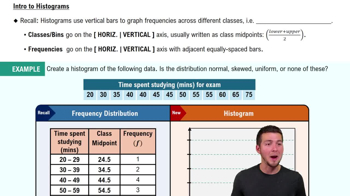
Intro to Histograms
465
views
11
rank
Terms in this set (15)
Hide definitions
What type of data are histograms used to visualize?
Histograms are used to visualize quantitative data.
What does a histogram graphically represent?
A histogram is a graphical representation of a frequency distribution.
Which axis of a histogram is labeled with class midpoints?
The x-axis of a histogram is labeled with class midpoints.
What is plotted on the y-axis of a histogram?
The y-axis of a histogram is labeled with frequencies.
How are the bars in a histogram supposed to be drawn?
The bars in a histogram are supposed to touch each other.
How do you calculate a class midpoint for a histogram?
You calculate a class midpoint by averaging the upper and lower class limits.
What is the first step before creating a histogram from a dataset?
The first step is to build a frequency distribution from the dataset.
What are the four common shapes of histogram distributions?
The four common shapes are normal, skewed right, skewed left, and uniform.
Describe a normal distribution shape in a histogram.
A normal distribution is bell-shaped, peaking in the middle and tapering off at both ends.
What does a skewed right distribution look like in a histogram?
A skewed right distribution peaks to the left and trails off to the right.
What is an example of a skewed right distribution?
Annual incomes are an example of a skewed right distribution.
How does a skewed left distribution appear in a histogram?
A skewed left distribution peaks to the right and trails off to the left.
What is an example of a skewed left distribution?
Life expectancies are an example of a skewed left distribution.
What characterizes a uniform distribution in a histogram?
A uniform distribution has equal or nearly equal frequencies across all classes.
Why are histograms useful for statistical analysis?
Histograms help identify patterns and trends in data, aiding statistical analysis and decision-making.
 BackBack

 05:54
05:54