Skip to main content
Statistics for Business
My Course
Learn
Exam Prep
AI Tutor
Study Guides
Flashcards
Explore
Try the app
My Course
Learn
Exam Prep
AI Tutor
Study Guides
Flashcards
Explore
Try the app
Back
Hypothesis Testing: Proportions - Excel definitions
You can tap to flip the card.
Null Hypothesis
You can tap to flip the card.
👆
Null Hypothesis
A statement asserting that a population parameter equals a specific value, serving as the default assumption in statistical testing.
Track progress
Control buttons has been changed to "navigation" mode.
1/15
Related flashcards
Related practice
Recommended videos
Hypothesis Testing: Proportions - Excel quiz
Hypothesis Testing: Proportions - Excel
15 Terms
9. Hypothesis Testing for One Sample
3 topics
15 problems
Chapter
Brendan
Guided course
08:19
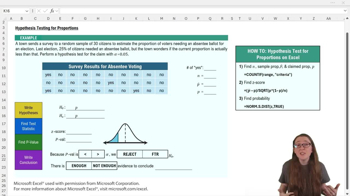
Performing Hypothesis Tests: Proportions - Excel
80
views
Guided course
10:24
Performing Hypothesis Tests: Proportions - Excel Example 2
69
views
Guided course
08:31
Performing Hypothesis Tests: Proportions - Excel Example 1
61
views
Terms in this set (15)
Hide definitions
Null Hypothesis
A statement asserting that a population parameter equals a specific value, serving as the default assumption in statistical testing.
Alternative Hypothesis
A claim suggesting a population parameter differs from the null value, representing what evidence is being sought in the test.
Population Proportion
A value representing the fraction of individuals in a population with a particular characteristic, often denoted as p.
Sample Proportion
A value calculated by dividing the number of successes in a sample by the sample size, providing an estimate of the population proportion.
Alpha Level
A threshold probability, often set at 0.05, used to determine whether to reject the null hypothesis.
Z-Score
A standardized value indicating how many standard errors a sample proportion is from the hypothesized population proportion.
P-Value
A probability measuring the strength of evidence against the null hypothesis, calculated from the test statistic.
Test Statistic
A calculated value, such as a z-score, summarizing sample data for comparison with a theoretical distribution.
Standard Normal Distribution
A bell-shaped curve with mean zero and standard deviation one, used to interpret z-scores and probabilities.
Left Tail Probability
A cumulative probability representing the likelihood of observing a value less than or equal to a given test statistic.
Sample Size
The total number of observations or responses collected in a study, often denoted as n.
Excel Function
A built-in computational tool, such as COUNTIF or NORM.S.DIST, used to automate statistical calculations.
Critical Value
A cutoff point on the test statistic scale that determines the boundary for rejecting the null hypothesis.
Statistical Inference
A process of drawing conclusions about a population based on sample data and probability models.
Cumulative Distribution Function
A function that gives the probability a random variable is less than or equal to a specific value.
 BackBack
 08:19
08:19