Skip to main content
Statistics for Business
My Course
Learn
Exam Prep
AI Tutor
Study Guides
Flashcards
Explore
Try the app
My Course
Learn
Exam Prep
AI Tutor
Study Guides
Flashcards
Explore
Try the app
Back
Intro to Stats definitions
You can tap to flip the card.
Statistics
You can tap to flip the card.
👆
Statistics
Branch of science focused on collecting and analyzing data to inform decisions about groups.
Track progress
Control buttons has been changed to "navigation" mode.
1/14
Related flashcards
Related practice
Recommended videos
Intro to Stats quiz #1
Intro to Stats
10 Terms
Intro to Stats
1. Introduction to Statistics
10 problems
Topic
Brendan
Intro to Collecting Data
1. Introduction to Statistics
10 problems
Topic
Ernest
1. Introduction to Statistics
3 topics
15 problems
Chapter
Brendan
Guided course
05:53
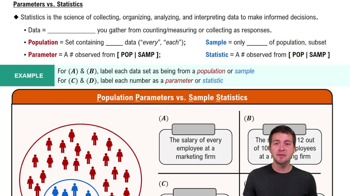
Parameters vs. Statistics
3393
views
153
rank
Guided course
04:24
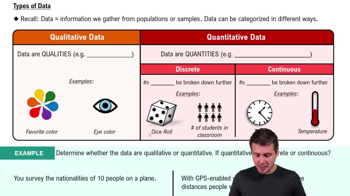
Types of Data
1369
views
80
rank
Terms in this set (14)
Hide definitions
Statistics
Branch of science focused on collecting and analyzing data to inform decisions about groups.
Data
Information gathered through counting, measuring, or recording responses from individuals or objects.
Population
Entire group of individuals or items of interest from which data could be collected.
Sample
Subset of a population selected for analysis to draw conclusions about the whole group.
Parameter
Single value summarizing a characteristic of an entire population, such as an average.
Statistic
Single value summarizing a characteristic of a sample, used to estimate population features.
Qualitative Data
Information described by attributes, labels, or categories, not suitable for arithmetic operations.
Quantitative Data
Information represented by numerical values, allowing for mathematical calculations.
Discrete Variable
Numerical value that can only take specific, countable outcomes, such as whole numbers.
Continuous Variable
Numerical value that can be subdivided infinitely, including decimals and fractions.
Attribute
Characteristic or quality used to describe or categorize qualitative data.
Measurement
Process of assigning numbers to characteristics, often resulting in quantitative data.
Count
Total number of occurrences or items, typically associated with discrete variables.
Category
Group or class used to organize qualitative data based on shared attributes.
 BackBack

 05:53
05:53