Skip to main content
Statistics for Business
My Course
Learn
Exam Prep
AI Tutor
Study Guides
Flashcards
Explore
Try the app
My Course
Learn
Exam Prep
AI Tutor
Study Guides
Flashcards
Explore
Try the app
Back
Multiplication Rule: Independent Events definitions
You can tap to flip the card.
Independent Events
You can tap to flip the card.
👆
Independent Events
Two outcomes where the result of one does not influence the result of the other in any way.
Track progress
Control buttons has been changed to "navigation" mode.
1/15
Related flashcards
Related practice
Recommended videos
Multiplication Rule: Independent Events quiz
Multiplication Rule: Independent Events
15 Terms
Multiplication Rule: Independent Events
4. Probability
10 problems
Topic
Ernest
Introduction to Contingency Tables
4. Probability
7 problems
Topic
Ernest
4. Probability
9 topics
15 problems
Chapter
Ernest
05:54
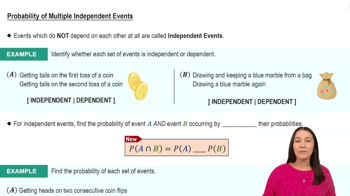
Probability of Multiple Independent Events
531
views
14
rank
Terms in this set (15)
Hide definitions
Independent Events
Two outcomes where the result of one does not influence the result of the other in any way.
Dependent Events
Two outcomes where the result of one changes the likelihood of the other occurring.
Probability
A numerical measure representing the chance of a specific outcome among all possible outcomes.
And Probability
The likelihood of two or more outcomes all occurring, found by multiplying their individual probabilities.
Set Notation
A symbolic way to represent relationships between events, often using symbols like the upside-down U for 'and.'
Coin Flip
A random experiment with two equally likely outcomes, typically heads or tails.
Six-Sided Die
A cube-shaped object with faces numbered 1 through 6, each equally likely to land face up.
Outcome
A possible result from a random experiment, such as a specific side of a die or coin.
Sample Space
The complete set of all possible outcomes for a random experiment.
Multiplication Rule
A principle stating that the probability of several independent outcomes is the product of their individual probabilities.
Event
A collection of one or more outcomes from a random process, often of interest in probability calculations.
Decimal Probability
A probability value expressed as a decimal, such as 0.25, representing the chance of an event.
Fractional Probability
A probability value expressed as a fraction, such as 1/4, representing the chance of an event.
Consecutive Trials
Multiple random experiments performed one after another, such as repeated coin flips or die rolls.
Possible Outcomes
All distinct results that can occur from a random experiment, forming the basis for probability calculations.
 BackBack
 05:54
05:54