Skip to main content
Statistics for Business
My Course
Learn
Exam Prep
AI Tutor
Study Guides
Flashcards
Explore
Try the app
My Course
Learn
Exam Prep
AI Tutor
Study Guides
Flashcards
Explore
Try the app
Back
Sampling Methods definitions
You can tap to flip the card.
Population
You can tap to flip the card.
👆
Population
Entire group of individuals or items about which information is desired for a statistical study.
Track progress
Control buttons has been changed to "navigation" mode.
1/15
Related flashcards
Related practice
Recommended videos
Sampling Methods quiz
Sampling Methods
15 Terms
Sampling Methods
1. Introduction to Statistics
10 problems
Topic
Ally
Intro to Collecting Data
1. Introduction to Statistics
10 problems
Topic
Ernest
1. Introduction to Statistics
3 topics
15 problems
Chapter
Brendan
Guided course
04:17
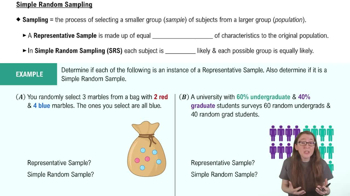
Simple Random Sampling
948
views
25
rank
Guided course
01:30
Simple Random Sampling Example 1
495
views
14
rank
Guided course
03:07
Sampling Methods Example 2
366
views
23
rank
Terms in this set (15)
Hide definitions
Population
Entire group of individuals or items about which information is desired for a statistical study.
Sample
Subset of a population selected for analysis to draw conclusions about the whole group.
Representative Sample
Subset mirroring the population's characteristics, ensuring similar proportions of key traits.
Simple Random Sampling
Technique where every member and possible subset has an equal chance of being chosen.
SRS
Abbreviation for the method where selection is entirely random and unbiased among all members.
Systematic Sampling
Procedure involving selection of every kth subject from an ordered population list.
Cluster Sampling
Method dividing the population into groups, then randomly selecting entire groups for study.
Cluster
Naturally occurring group within a population, used as a unit for certain sampling methods.
Stratified Sampling
Approach dividing the population into subgroups, then randomly selecting from each subgroup.
Strata
Subgroups within a population sharing a common characteristic, used in certain sampling designs.
Sampling Error
Difference between sample results and the actual population values due to chance selection.
Random Number Generator
Tool or process used to ensure unbiased selection in random sampling procedures.
Subgroup
Section of a population defined by a shared attribute, often used in stratified designs.
Interval
Fixed step or gap used in systematic sampling to select subjects from a population.
Statistical Conclusion
Inference or decision about a population based on analysis of sample data.
 BackBack


 04:17
04:17