Skip to main content
Statistics for Business
My Course
Learn
Exam Prep
AI Tutor
Study Guides
Flashcards
Explore
Try the app
My Course
Learn
Exam Prep
AI Tutor
Study Guides
Flashcards
Explore
Try the app
Back
Time-Series Graph definitions
You can tap to flip the card.
Time Series Graph
You can tap to flip the card.
👆
Time Series Graph
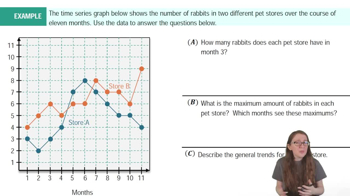
A visual tool that displays how a variable’s value changes at different points across a time interval using connected coordinate pairs.
Track progress
Control buttons has been changed to "navigation" mode.
1/15
Related flashcards
Related practice
Recommended videos
Time-Series Graph quiz #1
Time-Series Graph
10 Terms
Time-Series Graph
2. Describing Data with Tables and Graphs
10 problems
Topic
Ally
Stemplots (Stem-and-Leaf Plots)
2. Describing Data with Tables and Graphs
10 problems
Topic
David-Paige
2. Describing Data with Tables and Graphs
10 topics
15 problems
Chapter
David-Paige
Guided course
04:13
Creating Time-Series Graphs
260
views
5
rank
Guided course
04:36
Example 1
193
views
7
rank
Terms in this set (15)
Hide definitions
Time Series Graph
A visual tool that displays how a variable’s value changes at different points across a time interval using connected coordinate pairs.
Coordinate Pair
A set of two values representing a specific time and its corresponding measured value, plotted as a point on a graph.
X-Axis
The horizontal line on a graph that represents the progression of time intervals, such as months or years.
Y-Axis
The vertical line on a graph that shows the measured value of the variable at each time point.
Trend
A general direction in which data points move over time, revealing patterns like upward or downward movement.
Increase
A period where the measured values rise as time progresses, shown by an upward movement on the graph.
Decrease
A period where the measured values fall as time progresses, shown by a downward movement on the graph.
Segment
A straight line connecting two plotted points, used to visually link data and highlight changes between time intervals.
Scale
A consistent set of values on an axis that ensures all data points fit and trends are easily observed.
Interval
A specific span of time, such as a month or year, over which data is measured and plotted.
Data Table
An organized display of time intervals and their corresponding measured values, used as a reference for plotting.
Label
A descriptive text on an axis that clarifies what variable or unit is being represented.
Value
A numerical measurement recorded at a specific time, represented on the vertical axis of the graph.
Span
The total range of time covered by the data, from the earliest to the latest interval.
Point
A specific location on the graph where a coordinate pair is plotted, representing a value at a certain time.
 BackBack

 04:13
04:13