A two-way ANOVA analyzes the effects of two factors and their interaction on the means of groups, helping to determine if either factor or their combination influences outcomes.
What is the first hypothesis test performed in a two-way ANOVA?
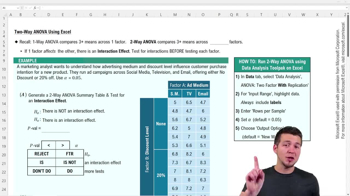
The first test is for the interaction effect between the two factors, to see if their combination influences the outcome differently than each factor alone.
What is the null hypothesis (H0) for the interaction effect in two-way ANOVA?
The null hypothesis states that there is no interaction effect between the two factors.
What does a p-value greater than alpha (e.g., 0.05) indicate in the interaction effect test?
It indicates that you fail to reject the null hypothesis, meaning there is not enough evidence for an interaction effect.
What should you do if an interaction effect is found in two-way ANOVA?
If an interaction effect exists, you stop further testing because it's unclear whether differences in means are due to individual factors or their interaction.
What are the two factors in the example problem discussed in the transcript?
The two factors are advertising medium (social media, TV, email) and discount level (no discount, 20% discount).
How do you set up the data in Excel for a two-way ANOVA with replication?
Select the input range including all data and labels, specify the number of rows per sample for factor B, and choose the output option for the summary table.
What does the 'columns' row in the ANOVA summary table represent?
The 'columns' row represents the effect of the first factor, which in the example is the advertising medium.
What is the null hypothesis for testing the effect of advertising medium in two-way ANOVA?
The null hypothesis is that there is no difference in means due to the advertising medium.
How do you interpret a low p-value (e.g., 0.007) for the advertising medium factor?
A low p-value means you reject the null hypothesis, indicating a significant difference in means due to advertising medium.
What is the null hypothesis for testing the effect of discount level in two-way ANOVA?
The null hypothesis is that there is no difference in means due to the discount level.
How do you interpret a low p-value for the discount level factor?
A low p-value means you reject the null hypothesis, indicating a significant difference in means due to discount level.
Can both factors in a two-way ANOVA show significant effects at the same time?
Yes, both advertising medium and discount level can independently show significant differences in means.
Why is it important to test for interaction effects before testing main effects in two-way ANOVA?
Interaction effects can complicate interpretation, so testing them first ensures that main effects are not confounded by combined influences.
What business scenario was used as an example for two-way ANOVA in the transcript?
The example involved a marketing analyst studying how advertising medium and discount level affect customer purchase intention for a new product.
 Back
Back
 08:34
08:34