 Back
BackChapter 17: Comparison – Statistical Methods for Comparing Groups
Study Guide - Smart Notes
 Tailored notes based on your materials, expanded with key definitions, examples, and context.
Chapter 17: Comparison
17.1 Data for Comparisons
Comparing two groups is a fundamental task in business statistics, often used to determine if a new treatment, product, or strategy is more effective than an existing one. Inferential statistics allow us to test for differences between two populations using sample data.
Key Point 1: Framing the Comparison: Define the parameter of interest (e.g., difference in proportions or means) and set up hypotheses to test whether the observed difference is statistically significant.
Key Point 2: Example – Diet Comparison: Suppose a fitness chain wants to know if a proprietary diet leads to higher membership renewal rates than the conventional diet. Let pA be the proportion renewing on the Atkins diet, and pC for the conventional diet. The difference pA - pC measures the effect of the new diet.
Key Point 3: Hypotheses: To be profitable, the difference must exceed 4%.
Key Point 4: Confounding: Confounding occurs when the effects of two or more factors are mixed, making it difficult to attribute differences to the treatment alone. Randomization helps eliminate confounding. If randomization is not possible, ensure independent sampling from each population.
Summary Statistics – Diet Comparison
Summary statistics, such as sample proportions and their confidence intervals, are used to compare groups. Overlapping confidence intervals suggest no significant difference, while non-overlapping intervals indicate a statistically significant difference.
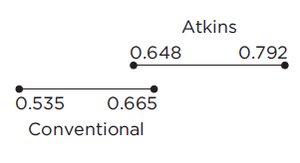
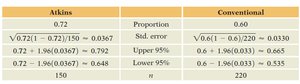
Example: The 95% confidence interval for the difference in renewal proportions (Atkins vs. Conventional) is (0.023, 0.217), which does not include zero, indicating a statistically significant difference.
Interpreting the Confidence Interval
If the confidence interval for the difference between two proportions (or means) does not include zero, we conclude that the groups are statistically significantly different. In the diet example, members on the Atkins diet renew at a higher rate than those on the conventional diet.
17.2 Two-Sample t-Test
The two-sample t-test is used to compare the means of two independent groups. It is commonly applied when comparing average outcomes, such as prices or sales, between two categories.
Key Point 1: Setting Up the Test: Define population means (e.g., μ1 for four-wheel drive cars, μ2 for two-wheel drive cars). The null hypothesis typically states that the difference is less than or equal to a constant D0 (often zero):
Key Point 2: Checklist for Validity:
No obvious lurking variables
Simple random samples (SRS)
Similar variances (though the test can adjust for differences)
Adequate sample size
Key Point 3: Confidence Interval Interpretation: If the 95% confidence interval for the difference in means does not include zero, the means are statistically significantly different.
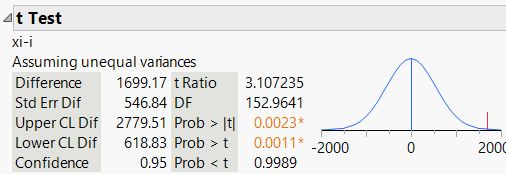
Practice Question: Matched Pairs t-Test
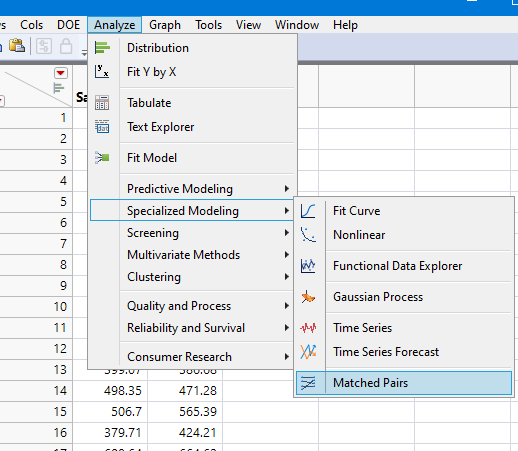
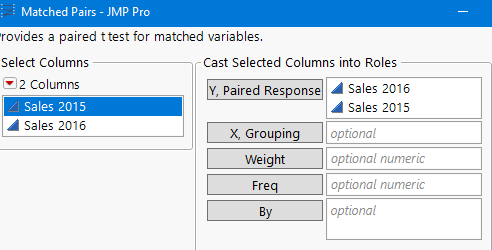
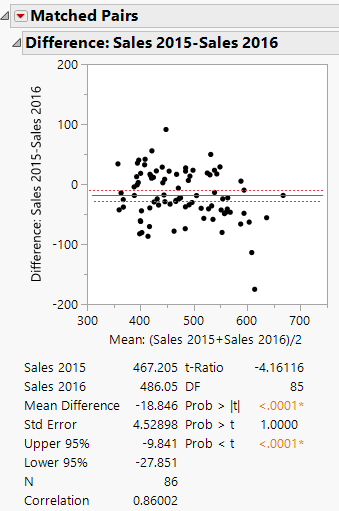
When comparing two measurements from the same group (e.g., sales in 2015 vs. 2016 for the same stores), use a matched pairs t-test. This accounts for the paired nature of the data and increases statistical power.
Key Point 1: Data Structure: Each pair consists of two related observations (e.g., sales for the same store in two years).
Key Point 2: Hypothesis Test: Test whether the mean difference is zero. If the confidence interval for the mean difference does not include zero, there is a statistically significant change.
Key Point 3: Example: For 86 retail outlets, the 95% confidence interval for the difference in sales (2015 - 2016) is (−27.85, −9.84). Since zero is not included, sales changed significantly.
Formulas and Calculations
Confidence Interval for a Proportion:
Confidence Interval for Difference in Proportions:
Two-Sample t-Test Statistic:
Matched Pairs t-Test Statistic: where is the mean of the differences, is the standard deviation of the differences, and is the number of pairs.
Summary Table: Types of Comparisons
Comparison Type | Test Used | Example |
|---|---|---|
Two independent proportions | z-test for proportions | Diet renewal rates |
Two independent means | Two-sample t-test | Car prices by drive type |
Paired means | Matched pairs t-test | Sales in 2015 vs. 2016 for same stores |
