17–83. Limits Evaluate the following limits. Use l’Hôpital’s Rule when it is convenient and applicable.
lim_z→0 (tan 4z) / (tan 7z)
Verified step by step guidance
1
Identify the form of the limit as z approaches 0. Both the numerator tan(4z) and the denominator tan(7z) approach 0, creating an indeterminate form 0/0.
Since the limit is in the indeterminate form 0/0, apply l'Hôpital's Rule, which allows us to differentiate the numerator and the denominator separately.
Differentiate the numerator: The derivative of tan(4z) with respect to z is 4 * sec^2(4z).
Differentiate the denominator: The derivative of tan(7z) with respect to z is 7 * sec^2(7z).
Evaluate the new limit: lim_{z→0} (4 * sec^2(4z)) / (7 * sec^2(7z)). As z approaches 0, sec^2(4z) and sec^2(7z) both approach 1, simplifying the limit to 4/7.
Verified video answer for a similar problem:

This video solution was recommended by our tutors as helpful for the problem above
Video duration:
7m
Play a video:
0 Comments
Key Concepts
Here are the essential concepts you must grasp in order to answer the question correctly.
Limits
Limits are fundamental concepts in calculus that describe the behavior of a function as its input approaches a certain value. They help in understanding the function's behavior near points of interest, including points of discontinuity or indeterminate forms. Evaluating limits is essential for defining derivatives and integrals, which are core components of calculus.
L'Hôpital's Rule is a method used to evaluate limits that result in indeterminate forms, such as 0/0 or ∞/∞. The rule states that if the limit of f(z)/g(z) leads to an indeterminate form, the limit can be found by taking the derivative of the numerator and the derivative of the denominator separately. This process can be repeated if the result remains indeterminate, making it a powerful tool for limit evaluation.
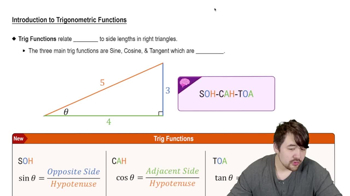
Trigonometric functions, such as tangent, sine, and cosine, are periodic functions that relate angles to ratios of sides in right triangles. In the context of limits, understanding the behavior of these functions as their arguments approach certain values is crucial. For example, the tangent function approaches 0 as its argument approaches 0, which is relevant when evaluating limits involving tan(4z) and tan(7z) as z approaches 0.