17–83. Limits Evaluate the following limits. Use l’Hôpital’s Rule when it is convenient and applicable.
lim_x→π (cos x +1 ) / (x - π )²
Verified step by step guidance
1
First, identify the form of the limit as x approaches π. Substitute x = π into the expression (cos x + 1) / (x - π)². You will find that both the numerator and the denominator approach 0, indicating a 0/0 indeterminate form.
Since the limit is in an indeterminate form, l'Hôpital's Rule can be applied. This rule states that if the limit of f(x)/g(x) as x approaches a point is indeterminate, then the limit is the same as the limit of f'(x)/g'(x) as x approaches that point, provided the derivatives exist.
Differentiate the numerator, cos(x) + 1, with respect to x. The derivative of cos(x) is -sin(x), and the derivative of the constant 1 is 0. Therefore, the derivative of the numerator is -sin(x).
Differentiate the denominator, (x - π)², with respect to x. Using the power rule, the derivative of (x - π)² is 2(x - π).
Apply l'Hôpital's Rule by taking the limit of the new expression: lim_x→π (-sin(x)) / (2(x - π)). Substitute x = π into this expression to evaluate the limit. Since sin(π) = 0, the numerator becomes 0, and the denominator becomes 2(π - π) = 0, indicating another 0/0 form. You may need to apply l'Hôpital's Rule again or simplify further to find the limit.
Verified video answer for a similar problem:

This video solution was recommended by our tutors as helpful for the problem above
Video duration:
11m
Play a video:
0 Comments
Key Concepts
Here are the essential concepts you must grasp in order to answer the question correctly.
Limits
Limits are fundamental concepts in calculus that describe the behavior of a function as its input approaches a certain value. They help in understanding the function's behavior near points of interest, including points where the function may not be explicitly defined. Evaluating limits is crucial for determining continuity, derivatives, and integrals.
L'Hôpital's Rule is a method used to evaluate limits that result in indeterminate forms, such as 0/0 or ∞/∞. The rule states that if the limit of f(x)/g(x) leads to an indeterminate form, the limit can be found by taking the derivative of the numerator and the derivative of the denominator separately, and then re-evaluating the limit. This technique simplifies the process of finding limits in complex scenarios.
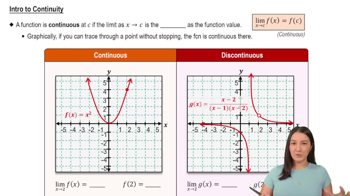
Continuity refers to a property of functions where they do not have any abrupt changes, jumps, or breaks at a given point. A function is continuous at a point if the limit as the input approaches that point equals the function's value at that point. Understanding continuity is essential for evaluating limits, as discontinuities can lead to different limit behaviors.