{Use of Tech} Special curves The following classical curves have been studied by generations of mathematicians. Use analytical methods (including implicit differentiation) and a graphing utility to graph the curves. Include as much detail as possible.
x²/₃ + y²/₃ = 1 (Astroid or hypocycloid with four cusps)
Verified step by step guidance
1
Recognize that the given equation \(x^{\frac{2}{3}} + y^{\frac{2}{3}} = 1\) represents an astroid, which is a type of hypocycloid with four cusps.
To analyze the curve, start by considering the symmetry. The equation is symmetric with respect to both the x-axis and y-axis, meaning the curve will be symmetric in all four quadrants.
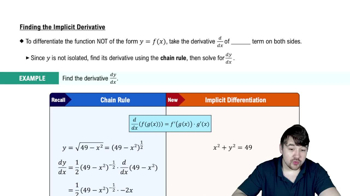
Use implicit differentiation to find the slope of the tangent line at any point on the curve. Differentiate both sides of the equation with respect to x, applying the chain rule: \(\frac{d}{dx}(x^{\frac{2}{3}}) + \frac{d}{dx}(y^{\frac{2}{3}}) = 0\).
Solve the resulting equation for \(\frac{dy}{dx}\) to find the expression for the slope of the tangent line. This will involve isolating \(\frac{dy}{dx}\) and simplifying the expression.
Use a graphing utility to plot the curve. Input the equation \(x^{\frac{2}{3}} + y^{\frac{2}{3}} = 1\) and observe the shape of the astroid, noting the four cusps where the curve meets the axes.
Verified video answer for a similar problem:
This video solution was recommended by our tutors as helpful for the problem above
Video duration:
5m
Play a video:
0 Comments
Key Concepts
Here are the essential concepts you must grasp in order to answer the question correctly.
Implicit Differentiation
Implicit differentiation is a technique used to find the derivative of a function when it is not explicitly solved for one variable in terms of another. In the context of the given equation, it allows us to differentiate both sides with respect to x, treating y as a function of x. This is particularly useful for curves defined by equations like the astroid, where y cannot be easily isolated.
A graphing utility is a software tool or calculator that allows users to visualize mathematical functions and curves. For the astroid defined by the equation x²/₃ + y²/₃ = 1, a graphing utility can help plot the curve accurately, revealing its shape and features such as cusps. This visual representation aids in understanding the behavior of the curve and its properties.
An astroid is a specific type of hypocycloid, characterized by its four cusps and a distinctive star-like shape. It can be represented parametrically or implicitly, as in the given equation. Understanding the properties of the astroid, including its symmetry and points of intersection with axes, is essential for analyzing its behavior and for applying calculus concepts like area and arc length.

 5:16 minutes
 Verified step by step guidance
 05:14
05:14