Step 1: Recognize that the first term involves the derivative of an integral with a variable upper limit. Apply the Fundamental Theorem of Calculus, which states that if F(t) = β«βα΅ f(π) dπ, then dF/dt = f(t). For the term d/dt β«βα΅ dπ/(1 + πΒ²), the derivative simplifies to f(t) = 1/(1 + tΒ²).
Step 2: Analyze the second term β«βΒΉ/α΅ dx/(1 + πΒ²). Notice that the limits of integration are reversed (1 to 1/t). Use the property of definite integrals that flipping the limits introduces a negative sign: β«βΒΉ/α΅ dx/(1 + πΒ²) = -β«ΒΉ/α΅β dx/(1 + πΒ²).
Step 3: Simplify the second term further. The integral β«ΒΉ/α΅β dx/(1 + πΒ²) is a definite integral with constant limits, so it does not depend on t. Evaluate this integral separately using standard techniques for integrating 1/(1 + πΒ²), which results in an arctangent function.
Step 4: Combine the results from Step 1 and Step 3. The derivative of the first term is 1/(1 + tΒ²), and the second term simplifies to a constant value (involving arctangent functions).
Step 5: Write the final simplified expression by combining the derivative of the first term and the constant value from the second term. Ensure clarity in the final form, but do not compute the numerical value.
Verified video answer for a similar problem:

This video solution was recommended by our tutors as helpful for the problem above
Video duration:
5m
Play a video:
0 Comments
Key Concepts
Here are the essential concepts you must grasp in order to answer the question correctly.
Fundamental Theorem of Calculus
The Fundamental Theorem of Calculus links differentiation and integration, stating that if a function is continuous on an interval, the derivative of its integral is the original function. This theorem allows us to evaluate the derivative of an integral, which is essential for simplifying expressions involving integrals.
The Chain Rule is a fundamental principle in calculus used to differentiate composite functions. When differentiating an integral with variable limits, the Chain Rule helps in applying the derivative to the upper limit of integration, ensuring that we account for the function's behavior at that point.
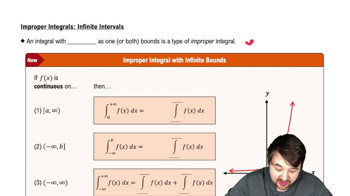
Improper integrals involve integrals with infinite limits or integrands that approach infinity within the interval of integration. Understanding how to handle these types of integrals is crucial when evaluating expressions that may include limits approaching zero or infinity, as seen in the second integral of the given expression.