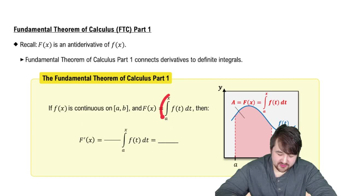
Step 1: Recognize that the problem involves the Fundamental Theorem of Calculus, which states that if F(x) = ∫ₐˣ f(t) dt, then dF/dx = f(x). This theorem will be key in solving the derivative of the integral.
Step 2: Analyze the given integral ∫₀ˣ (√1 + t²) dt. According to the Fundamental Theorem of Calculus, the derivative of this integral with respect to x is simply the integrand evaluated at the upper limit of integration, which is √(1 + x²).
Step 3: Consider the hint provided: ∫ˣ₋ₓ (√1 + t²) dt = ∫⁰₋ₓ (√1 + t²) dt + ∫ˣ₋ₓ (√1 + t²) dt. This suggests breaking the integral into parts, but for the derivative d/d𝓍 ∫₀ˣ (√1 + t²) dt, the hint is not directly necessary since the Fundamental Theorem of Calculus simplifies the process.
Step 4: Apply the Fundamental Theorem of Calculus directly to the integral ∫₀ˣ (√1 + t²) dt. The derivative with respect to x is simply √(1 + x²), as the lower limit of integration (0) does not contribute to the derivative.
Step 5: Conclude that the derivative of the given integral is √(1 + x²). The hint provided is more relevant for breaking down integrals with different limits, but in this case, the direct application of the theorem suffices.
Verified video answer for a similar problem:
This video solution was recommended by our tutors as helpful for the problem above
Video duration:
1m
Play a video:
0 Comments
Key Concepts
Here are the essential concepts you must grasp in order to answer the question correctly.
Fundamental Theorem of Calculus
The Fundamental Theorem of Calculus links differentiation and integration, stating that if F is an antiderivative of f on an interval [a, b], then the integral of f from a to b can be computed as F(b) - F(a). This theorem also implies that the derivative of an integral function is the integrand evaluated at the upper limit of integration.
Differentiation under the integral sign allows us to differentiate an integral with respect to a parameter. This technique is useful when the limits of integration or the integrand itself depend on a variable, enabling the evaluation of complex integrals by treating them as functions of that variable.
Integration by parts is a technique used to integrate products of functions. It is based on the product rule for differentiation and is expressed as ∫u dv = uv - ∫v du. This method can simplify the integration of more complex expressions, particularly when one function is easily integrable and the other is easily differentiable.

 1:42 minutes
 Verified step by step guidance
 06:11
06:11