72–86. Evaluating series Evaluate each series or state that it diverges. ∑ (k = 1 to ∞) ((1/3) × (5/6)ᵏ + (3/5) × (7/9)ᵏ)
Verified step by step guidance
1
Recognize that the given series is a sum of two separate infinite series: \( \sum_{k=1}^\infty \left( \frac{1}{3} \times \left( \frac{5}{6} \right)^k + \frac{3}{5} \times \left( \frac{7}{9} \right)^k \right) = \sum_{k=1}^\infty \frac{1}{3} \left( \frac{5}{6} \right)^k + \sum_{k=1}^\infty \frac{3}{5} \left( \frac{7}{9} \right)^k \).
Identify each series as a geometric series of the form \( \sum_{k=1}^\infty ar^k \), where \(a\) is the coefficient and \(r\) is the common ratio. For the first series, \(a = \frac{1}{3}\) and \(r = \frac{5}{6}\). For the second series, \(a = \frac{3}{5}\) and \(r = \frac{7}{9}\).
Check the convergence of each geometric series by verifying if the absolute value of the common ratio \( |r| < 1 \). Since \( \frac{5}{6} < 1 \) and \( \frac{7}{9} < 1 \), both series converge.
Use the formula for the sum of an infinite geometric series starting at \(k=1\): \[ S = \frac{ar}{1 - r} \]. Apply this formula to each series separately.
Calculate the sum of the original series by adding the sums of the two geometric series: \[ S_{total} = \frac{\frac{1}{3} \times \frac{5}{6}}{1 - \frac{5}{6}} + \frac{\frac{3}{5} \times \frac{7}{9}}{1 - \frac{7}{9}} \].
Verified video answer for a similar problem:
This video solution was recommended by our tutors as helpful for the problem above
Video duration:
3m
Play a video:
0 Comments
Key Concepts
Here are the essential concepts you must grasp in order to answer the question correctly.
Infinite Geometric Series
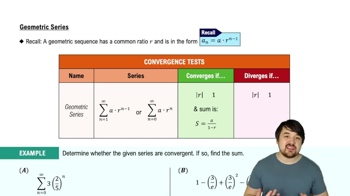
An infinite geometric series is a sum of terms where each term is a constant multiple (common ratio) of the previous one. It converges if the absolute value of the common ratio is less than 1, and its sum can be found using the formula S = a / (1 - r), where a is the first term and r is the common ratio.
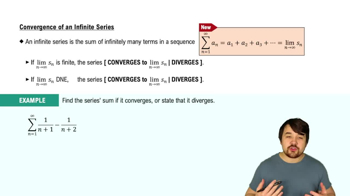
A series converges if the sequence of its partial sums approaches a finite limit; otherwise, it diverges. For geometric series, convergence depends on the common ratio's magnitude. Understanding convergence is essential to determine whether the series sum exists or not.
The sum of a series that is a sum of two series equals the sum of each series separately. This property allows breaking down complex series into simpler parts, evaluating each independently, and then combining the results to find the total sum.